01The brief goes out
Your written brief goes out through our supplier network of certified diamond houses.
Most engagement-ring diamonds we sell were not sitting in a display case when the client first walked in — they were sourced to a written brief through our international supplier network of certified diamond houses. The process is faster than people expect: a clear brief on Monday usually has viewable options by the end of the week, each one checked against whatever independent IGI or GIA grading report is available for it before anything changes hands.
See it before you decide
7 days
to inspect and decide
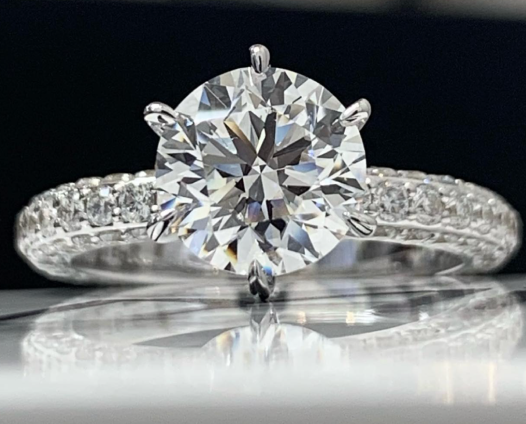
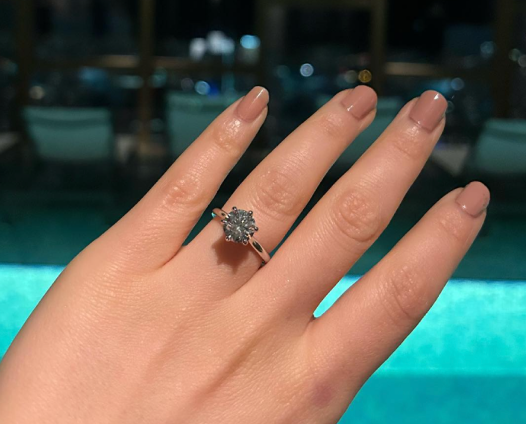
A sourced stone is chosen from paperwork, photography and video before it lands in Melbourne. That is why the 7-Day Diamond Showcase and Return Program sits at the centre of how we source: once the stone arrives in store you have seven days to view it in person, inspect it closely, and decide. The diamond stays in our showroom throughout.
If it is not what you expected, tell us within that window and we arrange its return to the supplier. A $150 return fee applies for shipping and customs. The program applies to a select number of suppliers rather than every stone on the site — we will confirm at the point of the brief.
Where the trade sits
Antwerp
Belgium
Mumbai
India
Tel Aviv
Israel
New York
United States
Dubai
UAE
The inventory those houses hold rotates quickly. Rather than buying a fixed catalogue forward and hoping it matches what the next client wants, we hold a small in-house inventory for browse and source the bulk of stones on request, against a written brief.
A brief starts with the four basics — shape, carat, colour, clarity — plus cut floor (Excellent only on round brilliants) and origin preference (natural or lab grown). From there we add the practical filters that matter to the finished ring.
Where every brief starts
The filters that shape the ring
Your written brief goes out through our supplier network of certified diamond houses.
Three to six stones that meet it. Where a GIA or IGI grading report is available for an individual stone, we work from the report number rather than the seller’s description, and most candidates also arrive with photography and a 360° video.
We check the candidates against the brief and eliminate any that look weaker than the paperwork suggests.
We present what survived, with the trade-offs stated plainly.
Two legitimate answers to the same brief
1.10ct natural
F–VS2, at the top of the budget
1.30ct lab grown
E–VS1, at the same total price
Clients see real options — not a stock-photo idealisation — and they see the trade-offs honestly. Both of these are legitimate answers to most engagement-ring briefs. We will tell you which we would choose and why, but the decision is yours.
Where the work pays off
Anyone can send you a list of stones that match a set of grades. The value is in what happens between the list and the shortlist.
Filtering fancy shapes
The bowtie is the single biggest thing separating two fancy-shape stones with identical certificates, and no lab grades it. We work through candidate videos shape by shape and keep only the cleanest light performance, so what reaches you is the best non-bowtie stone available in your brief — not simply the first one that matched on paper.
Making the budget go further
We know which specifications carry a premium that shows on the certificate but not in the hand, and where a grade can move without the eye noticing. Applied to a real budget, that knowledge buys a visibly better stone for the same spend — which is the whole point of sourcing to a brief rather than buying from a case.
It is more work. It is also the only way the client gets the best stone their money can buy.
Yes — this is the workflow we use most often.
“1.50ct round, D–G colour, VS2 minimum, Excellent cut, natural, under $12,000 inc. GST”
We run the search against the supplier network and almost always come back with multiple candidates within a few business days. The narrower the brief, the more interesting the search, but even tight criteria usually surface several real options.
If you have been quoted a stone by another jeweller and want a second opinion, we can look up that specific stone against the lab's database, confirm the grading, and check whether the price you have been quoted is fair against the current wholesale market.
Genuine certificates carry a laser inscription on the girdle that we verify under magnification at the consultation.
GIA doesn't issue an overall cut grade for fancies, so we screen candidates on polish, symmetry, length-to-width ratio, and videos showing actual light performance. Two emerald-cut stones with identical paperwork can look meaningfully different in the hand — we will not present a stone we have not visually assessed. On ovals, pears and marquises the giveaway is the bowtie: a dark band across the centre where the stone returns no light. No certificate grades it.
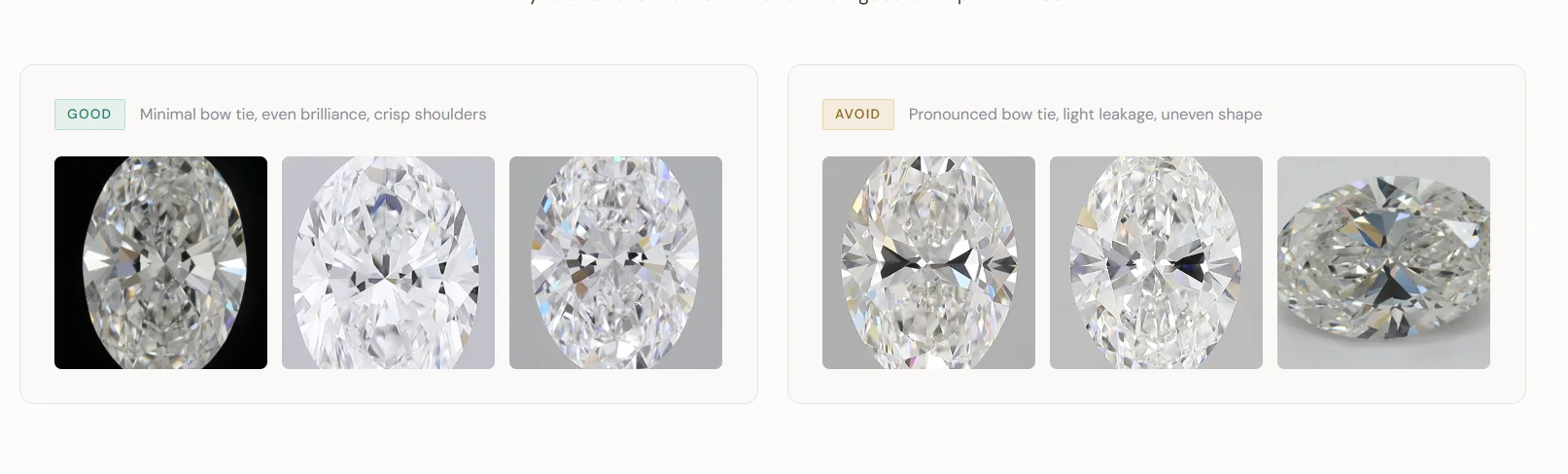
GoodMinimal bow tie, even brilliance, crisp shoulders
AvoidPronounced bow tie, light leakage, uneven shape
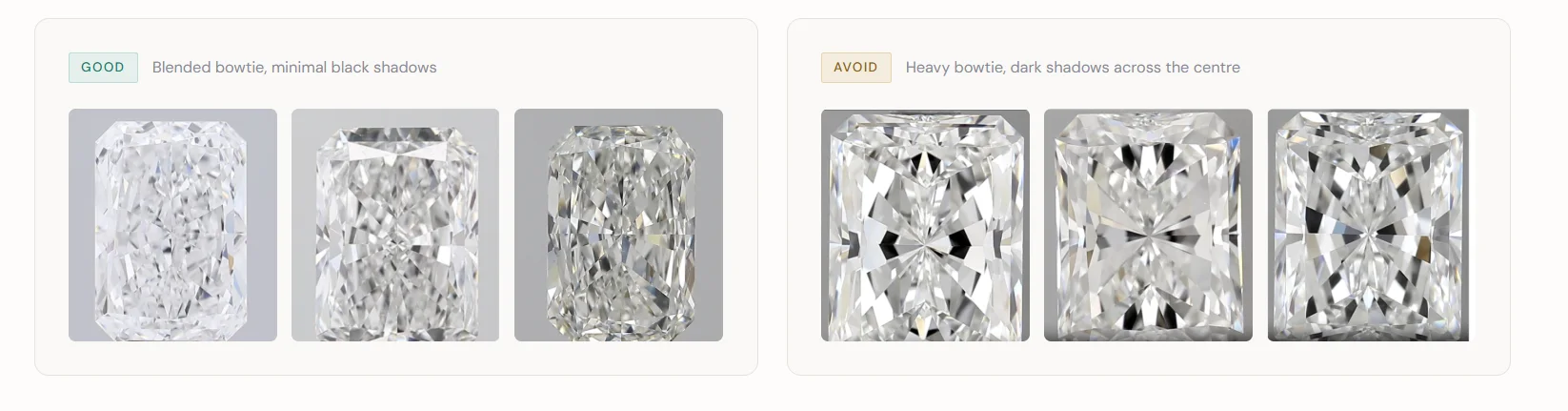
GoodBlended bowtie, minimal black shadows
AvoidHeavy bowtie, dark shadows across the centre
The same shape, the same paperwork, and a visibly different stone. This is what we are looking at when we screen candidate videos.
Two laboratories dominate diamond certification globally. Both grade the 4Cs — cut, colour, clarity, and carat — on the same scales, and both issue tamper-evident reports that travel with the stone for its life.
Gemological Institute of America
The long-standing gold standard for natural diamonds. Its reports are conservative on borderline calls and carry the highest market trust, especially at auction.
International Gemological Institute
The dominant certifier of lab grown diamonds and widely accepted for natural stones too — particularly in the European and Asian markets — with the same 4Cs grading rigour.
We review the actual GIA or IGI grading report available for an individual stone, together with the microscopic laser inscription on the girdle where one is present. The inscription ties the physical diamond to its report number — we verify it under magnification at the consultation, and you can independently verify an available report on the lab's public website before committing.
If a stone does not have a GIA or IGI grading report available, we say so before you decide. National and in-house laboratories vary widely in grading rigour, and a seller's own appraisal carries far less weight than an independent lab. If a stone you have been quoted elsewhere doesn't carry an IGI or GIA report, that is itself a useful signal worth discussing.
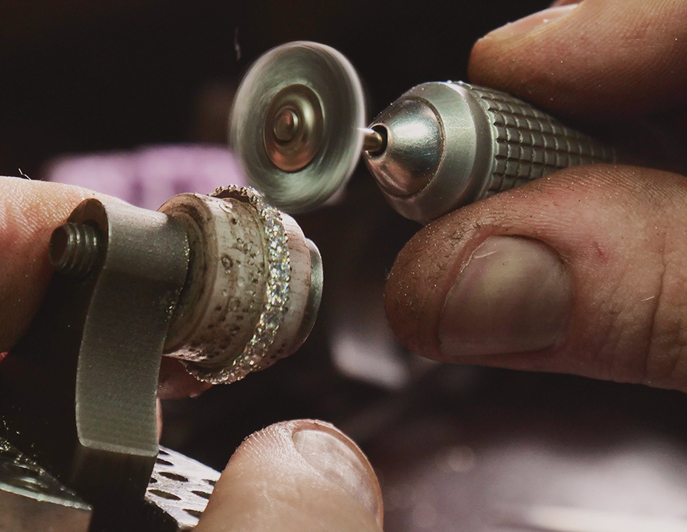
A typical brief returns a viewable shortlist within three to seven business days. The variability is mostly about specificity and shape availability.
For stones already paired with a lab report, photography and video, you can review the shortlist remotely and short-list one or two to view in person.
If the timeline is tight — a proposal date already booked, an anniversary in two weeks — tell us upfront. We can prioritise stones already in Melbourne or in fast-shipping transit lanes and skip candidates we would otherwise consider on a relaxed timeline. We will not let a deadline force you into a stone that doesn't meet the brief, but we will adjust the search to surface the strongest options that can land in time.
Shape, carat, colour, clarity and a budget is enough to start. We will source against it and come back with real options, and with the grading report for any stone that has one.
Keep reading
Made personal, at Anny's
Melbourne CBD
Email us before visiting Collins Street. Please wait for our email confirmation before coming in.
Arrange your visitOur Frankston home
Visit us to talk through your ideas, explore designs and find your perfect fit.
Explore our Frankston showroomTypical engagement and bridal ring turnaround: 3–4 weeks from CAD sign-off. We also have 2-week and 48-hour options for engagement and bridal rings. Get in touch and we'll help find an option that works for your timeframe.
Typical repair turnaround: 1 to 7 business days, depending on complexity and customer urgency
Anny's Manufacturing JewellersABN 88 447 171 579