Diamond education / Carat
Diamond carat: weight, size and choosing your diamond
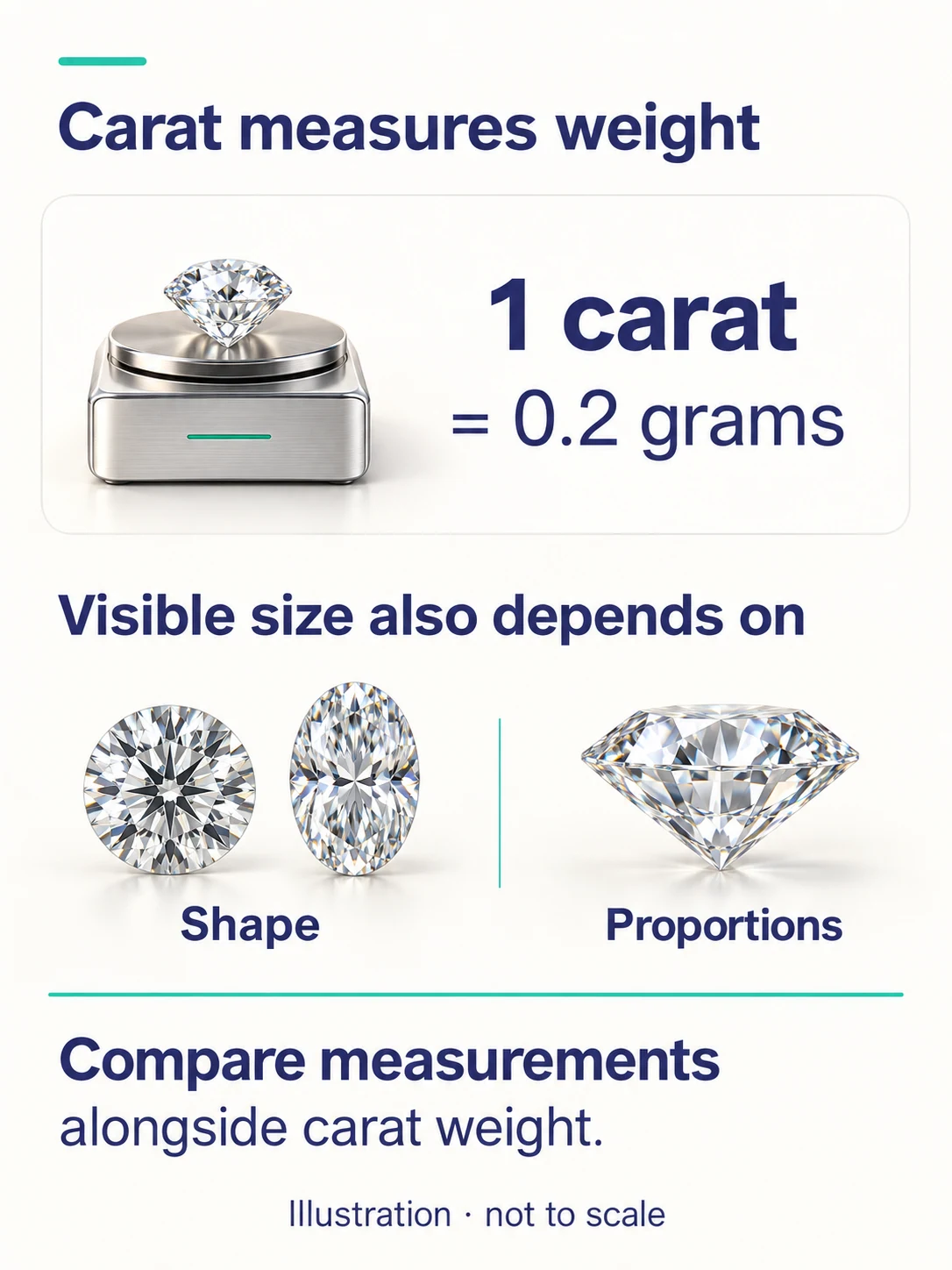
Carat tells you how much a diamond weighs. One carat is 0.2 grams, divided into 100 points. The size you see also depends on the diamond’s shape and proportions, so compare its millimetre measurements and appearance alongside its weight. For a finished ring, check whether the quoted carat weight describes the centre diamond or all the diamonds combined. GIA’s carat guide
What does a carat mean?
A 0.50 ct diamond weighs half a carat, or 50 points. A 0.75 ct diamond is 75 points, and 1.00 ct is one full carat. The abbreviation “ct” refers to the weight of the stone.
In Australia, “carat” also describes gold, such as 9ct or 18ct. For gold it means purity; for diamonds it means weight. Geoscience Australia on gold purity
Natural and lab-grown diamonds use the same unit: one carat weighs the same for both.
How big will the diamond look?
Look at the diamond’s face-up measurements: the dimensions across its top. A round diamond has a minimum and maximum diameter; an oval or other elongated shape has a length and width. The report also records depth.
There is no exact conversion from carats to millimetres that works for every diamond. Two stones of the same weight can have different dimensions because they carry that weight differently. Use the measurements on the particular stone’s report when comparing your shortlist. GIA on weight and appearance
Compare carat weights with GIA
Use GIA’s tool to compare two diamond weights. Its images show relative size, not actual-size measurements.
Courtesy of GIA®.

Shape and cut change the result
Oval, pear and marquise diamonds can create a longer outline on the finger than a round diamond of the same weight. Length alone does not tell the whole story: compare width too, and decide whether you prefer a slender or fuller shape. Our diamond shape comparison helps you explore those differences. GIA’s shape guide
A deep stone or a thick girdle—the edge around the diamond—can hold weight without adding much visible size. Width alone cannot establish cut quality: proportions also affect how the diamond handles light.
Compare the report, images or video and the diamond itself where possible. Our diamond cut guide explains what to consider beyond the carat figure.
Does a higher carat weight always cost more?
Carat influences price, but so do origin, shape, colour, clarity and cut quality. A heavier diamond can cost less than a lighter one with different specifications.
For natural diamonds, larger stones are rarer and the price per carat generally rises with size when other quality factors are comparable. Desirable weights such as 1.00, 1.50 and 2.00 ct can also attract a premium. GIA on carat and price
Compare stones just below and above your preferred weight. A slightly lighter diamond may offer a similar look for less; check the actual prices and measurements before deciding.
Example prices from Anny’s
All six examples below are round diamonds listed as G colour, VS2 clarity and Excellent cut. Natural examples list GIA reports; lab-grown examples list IGI reports.
| Carat weight / listing | Listed measurements | Loose-diamond price |
|---|---|---|
| 1.00 ct | 6.31 × 6.36 mm | A$5,669 |
| 1.50 ct | 7.21 × 7.30 mm | A$12,160 |
| 2.00 ct | 7.89 × 8.01 mm | A$23,884 |
| Carat weight / listing | Listed measurements | Loose-diamond price |
|---|---|---|
| 1.00 ct | 6.35 × 6.45 mm | A$1,487 |
| 1.50 ct | 7.26 × 7.32 mm | A$1,802 |
| 2.00 ct | 8.21 × 8.24 mm | A$2,173 |
Six individual listings, selected as the lowest-priced results at each weight and origin on 19 September 2026; prices rechecked 20 September 2026. Polish, symmetry and fluorescence can differ, so these are not averages or a controlled comparison.
Prices are in Australian dollars, including GST, for loose stones only; setting and making costs are additional. Prices and availability can change. A listing does not mean the stone is physically in either store.
Browse our natural diamonds and lab-grown diamonds separately. Keep your preferred shape and quality criteria consistent as you adjust carat weight, then compare the actual measurements and reports.
Centre-stone weight or total carat weight?
Total carat weight, often written TCW or ctw, adds together the diamond weights in a piece. It does not tell you the weight of its largest diamond.
For example, a ring with a 0.70 ct centre diamond and two 0.15 ct side diamonds has 1.00 ct total diamond weight. Its centre stone is still 0.70 ct. A solitaire with one 1.00 ct diamond also totals 1.00 ct, but its diamond arrangement and appearance are different. GIA on total carat weight

When comparing quotes, ask for the centre weight, combined side-stone weight and total weight. For earrings, check whether the advertised weight is for each earring or the pair. For mixed-stone jewellery, check which stones are included in the stated total.
How to choose a carat weight you will enjoy wearing
Start with the look and complete-ring budget you are comfortable with. Then compare a few options:
- Choose your preferred shape. Its outline helps determine how the diamond looks on your finger.
- Compare measurements as well as carats. Look at length and width, the proportions you like and the diamond’s brightness.
- Consider the whole setting. Band width, side stones and the setting’s height all influence the finished look. Try rings on to judge the scale and comfort for yourself.
- Allow for the finished ring. A loose-diamond price leaves the setting, metal and making costs to be quoted separately.
There is no single carat weight that suits everyone. A diamond that works with your hand, everyday activities and preferred design is a more useful goal than reaching a particular number.
Compare your options with Anny’s
We can help you compare natural and lab-grown diamonds and plan a custom-made ring around your preferred stone, style and budget.
Frankston: visit 92 Young Street. Walk-ins welcome; no appointment required. Monday–Friday 10am–5pm and Saturday 10am–3pm.
Melbourne CBD: Level 3, 257 Collins Street. Email us before visiting Collins Street for engagement-ring and wedding-ring consultations. Please wait for our email confirmation before coming in. Remodelling consultations take place at our Frankston workshop.
Email info@annys.com.au with your preferred shape, approximate carat range and complete-ring budget to discuss suitable stones and viewing arrangements.