Heart-Shaped Diamond Buying Guide
Written by Chris Ozkoch · Reviewed by Harry Ozkoch and Lisa D FGAA · Updated 2026-09-27
The heart shaped diamond is one of the most romantic and recognisable cuts — and one of the least forgiving. The shape's charm depends almost entirely on symmetry: the cleft and the two lobes must be balanced, the point must be sharp, and the outline must read as a heart at a glance. Below: what the cut actually is, why symmetry dominates the buying decision, how the 4Cs read on a heart, and which settings flatter the shape.
What is a heart-cut diamond?
The heart is a modified brilliant cut — typically 56 to 58 facets — arranged across a heart-shaped outline. The silhouette is defined by three features: a deep cleft at the top centre, two evenly-rounded lobes flanking the cleft, and a sharp single point at the bottom. Done well, the shape reads as an unmistakable heart from any viewing angle. Done poorly, the outline reads as an asymmetrical pear or a misshapen oval.
Heart cutting is technically demanding because the cut combines elements of two other shapes — the rounded lobes echo a round brilliant, while the tapered point echoes a pear — and the two halves of the stone must mirror each other precisely. Any wobble in lobe size, any tilt in the cleft, any shift in the point off-centre, and the shape stops looking like a heart. For this reason a heart with poor symmetry is one of the few diamond shapes that loses commercial value almost regardless of its colour and clarity grades.
The cut is most commonly used as a centre stone in pendants and earrings, less commonly in engagement rings. When used in a ring, it sits as a solitaire or in a halo — rarely in three-stone designs because matching three hearts for symmetry across one ring is supply-constrained and expensive.
How do the 4Cs apply to heart-cut diamonds?
Cut and symmetry: as with princess, the heart has no overall cut grade on GIA reports — you read cut from polish, symmetry, and the length-to-width ratio. Symmetry is the single most important grade on a heart-cut certificate. Look for Excellent or Very Good symmetry; anything graded Good or below will show visible lobe mismatch or off-centre points. Aim for a length-to-width ratio between 0.90 and 1.10 for a classic heart silhouette — outside that range the stone reads as either stubby or stretched.
Colour: like the round and the princess, heart cuts use brilliant faceting that masks body colour effectively. G–H grades read as colourless in most ring designs. However — and this is a heart-specific consideration — the tapered point at the bottom of the stone concentrates body colour because of the long facets running through it. On stones over 1.5ct, prefer F–G to keep the point reading clean.
Clarity: the point of the heart, like the corners of a princess, is a stress concentrator. Inclusions sitting near the point are visible and create a structural risk point. Look for VS2 or better, and study the certificate plot diagram to confirm the inclusions sit toward the centre of the stone or up near the lobes — not near the point and not near the cleft. Eye-clean SI1 hearts exist, but only when the plot is favourable.
Carat: hearts read smaller per carat than rounds because the cut is deep and the outline less efficient at covering the finger. We typically recommend a minimum centre stone weight of 0.50ct for a heart engagement ring — below that the outline is too small to read clearly as a heart at arm's length. Hearts in pendants and earrings can work down to 0.30ct comfortably because the viewer is closer.
Does colour matter on a heart cut?
Yes, particularly at the point. As above, the long facets running through the point concentrate body tint; on larger stones, F–G colour helps the point read cleanly. Below 1.00ct, H can also work comfortably in warm metal. We offer D–H colour grades. The GIA grades heart-cut colour on the same D–Z scale used for all white diamonds.
| Grade | Group | Description |
|---|---|---|
| D | Colourless | Highest grade. No detectable colour even under magnification. |
| E | Colourless | Minute traces of colour visible only to a trained gemmologist. |
| F | Colourless | Trace colour detectable by an expert grader; appears colourless to the untrained eye. |
| G | Near colourless | Very slight warm tint; appears colourless in most settings. |
| H | Near colourless | Slight warm tint visible against a pure-white background. |
| I | Near colourless | Noticeable warm tint, particularly in larger stones. |
| J | Near colourless | Slight yellow or brown tint visible to the unaided eye. |
| K–M | Faint | Noticeable yellow tint; often paired with warm-metal settings (yellow gold, rose gold). |
| N–R | Very light | Yellow tint clearly visible. |
| S–Y | Light | Strong yellow tint approaching fancy yellow territory. |
| Z | Light | Boundary of the normal-colour scale; anything beyond Z is graded as fancy yellow. |
Heart vs pear — how do they compare?
The heart and the pear share the same underlying brilliant faceting strategy and the same tapered-point geometry. In fact, a heart can be thought of as a pear with a notch cut into the rounded end — the cleft is what distinguishes the two shapes. That cleft adds technical difficulty: every heart cutter is doing pear-cutter work plus the additional symmetry constraint of the cleft and matched lobes.
The pear is more forgiving in wear. Its single tapered point is the only structural risk feature; a heart has two (the point and the cleft). The cleft is particularly exposed because the V-shape creates an inward-facing edge that's difficult to protect with a setting prong. Most well-designed heart settings use a single prong straddling the cleft and a second prong at the point — covering the two highest-risk regions.
On cost, a heart of equivalent colour, clarity, and carat typically commands a small premium over a pear — perhaps 5–15% — because supply is thinner. Fewer cutters attempt hearts at scale, and the rejection rate on a heart cutting plan is higher than on a pear because the symmetry constraints are tighter. That premium narrows on lab grown inventory, where the larger and more flexible rough supply makes heart-cutting more economical relative to pear.
| Criterion | Heart | Pear | Round |
|---|---|---|---|
| Symmetry sensitivity | Highest — Excellent / Very Good is the practical floor | High — outline is forgiving but the point must align | Lowest — GIA cut grade captures the whole picture |
| Structural risk points | Two: the point and the cleft | One: the tapered point | None — the outline has no concentrated stress points |
| Wear durability | Requires a setting that protects both point and cleft | Requires a setting that protects the point | Most durable shape for daily wear |
| $/carat cost | Small premium over pear; below round | Below round; one of the value shapes | Highest of the three |
What setting suits a heart cut?
Setting choice for a heart hinges on protecting the two structural risk points — the cleft at the top and the point at the bottom — while keeping the heart outline clearly readable. The setting must not visually crowd or crop the silhouette.
Five-prong solitaire: the classic heart setting, with one prong at the point, one straddling the cleft, and three around the lobes. Every risk feature is covered and the outline reads cleanly. Make sure the cleft prong is shaped to fit the V of the cleft rather than sitting on top of it — a flat-topped cleft prong reads as a fourth lobe and blurs the shape.
Halo with heart centre: a halo of melee around the centre stone visually enlarges a smaller heart and adds sparkle, while the melee contribute structural protection at the point and cleft. Especially flattering on centre stones under 0.75ct where the halo helps the heart shape register clearly at arm's length.
Bezel setting: a partial bezel that wraps the lobes leaving the cleft and point exposed gives a modern, architectural look. We use this style less often because a full bezel obscures the heart silhouette and a partial bezel requires precise metalwork to avoid looking unfinished.
Pendant setting: hearts work beautifully as pendants, where the orientation choice matters — point down (the romantic, “heart locket” orientation) or point up (the modern, geometric orientation). The bail attaches to the cleft, which doubles as cleft protection. Pendants tend to take more impact than ring stones, but hearts in pendants sit closer to the chest where impact is rare. We typically recommend hearts under 1.00ct for pendant work and reserve larger hearts for rings.
Across all of these, the metal choice follows the same logic as other brilliant cuts: white metals show D–H grades brightly, while yellow and rose metals can add warmth within the same offered range.
How does symmetry affect heart-cut diamonds?
Symmetry is more important than colour, clarity, or even cut polish on a heart. A heart with VS2 clarity, G colour, and Excellent polish but Good symmetry will look measurably worse than a heart with SI1 clarity, H colour, and Excellent symmetry. Why? Because the eye reads the outline before it reads the sparkle — if the outline is wobbly, the stone registers as “not quite right” before any other quality marker enters the assessment.
When sourcing a heart for a client, we filter on symmetry first and the rest of the 4Cs second. We'd rather show a client an SI1/H heart with Excellent symmetry than a VVS1/D heart with Good symmetry — the first sparkles cleanly and reads as a heart; the second looks like a stone that was cut wrong. Clarity also matters at the body of the stone because inclusions near the cleft or the point compound the symmetry issue by visually disrupting the silhouette. The clarity scale below applies in the standard way for any white diamond.
| Grade | Group | Description |
|---|---|---|
| FL | Flawless | No inclusions or blemishes visible to a skilled grader under 10× magnification. |
| IF | Internally Flawless | No inclusions visible under 10× magnification. Only surface blemishes. |
| VVS1 | Very Very Slightly Included | Minute inclusions extremely difficult to see at 10× magnification. |
| VVS2 | Very Very Slightly Included | Minute inclusions very difficult to see at 10× magnification. |
| VS1 | Very Slightly Included | Minor inclusions difficult to see at 10× magnification. |
| VS2 | Very Slightly Included | Minor inclusions somewhat easy to see at 10× magnification. |
| SI1 | Slightly Included | Noticeable inclusions easy to see at 10× magnification with a jeweller's loupe; typically not visible to the unaided eye. |
| SI2 | Slightly Included | Noticeable inclusions sometimes visible to the unaided eye. |
| I1 | Included | Inclusions visible to the unaided eye; may affect brilliance. |
| I2 | Included | Obvious inclusions; brilliance reduced. |
| I3 | Included | Heavy inclusions; structural integrity may be affected. |
Further reading
For the underlying 4Cs methodology used to grade every heart-cut diamond, the authoritative third-party references are:
Heart cut diamond size chart
What a heart cut's measurements mean in carat weight. Note the column order: a heart is wider than it is long, at a length-to-width ratio of about 0.90, which is the single most commonly mis-stated fact about the shape. Every row from 0.30ct up is the median of real certified hearts in our own inventory, with the sample size beside it.
| Length × width | Carat weight | Typical range | Based on |
|---|---|---|---|
| 2.0 × 2.3 mm | 0.034 ct | — | Calculated |
| 2.5 × 2.8 mm | 0.067 ct | — | Calculated |
| 3.0 × 3.4 mm | 0.12 ct | — | Calculated |
| 3.5 × 3.9 mm | 0.18 ct | — | Calculated |
| 4.0 × 4.5 mm | 0.28 ct | — | Calculated |
| 4.6 × 5.2 mm | 0.42 ct | 0.37–0.50 ct | 63 stones |
| 4.9 × 5.6 mm | 0.51 ct | 0.48–0.56 ct | 166 stones |
| 5.0 × 5.7 mm | 0.55 ct | 0.50–0.68 ct | 595 stones |
| 5.5 × 6.2 mm | 0.72 ct | 0.65–0.92 ct | 1,222 stones |
| 6.0 × 6.9 mm | 1.01 ct | 0.90–1.08 ct | 3,195 stones |
| 6.5 × 7.1 mm | 1.07 ct | 1.01–1.30 ct | 3,238 stones |
| 7.0 × 8.0 mm | 1.52 ct | 1.36–1.70 ct | 2,344 stones |
| 7.5 × 8.3 mm | 1.77 ct | 1.53–2.07 ct | 1,989 stones |
| 7.7 × 8.7 mm | 2.00 ct | 2.01–2.83 ct | 184 stones |
| 8.0 × 9.0 mm | 2.12 ct | 2.01–2.83 ct | 2,266 stones |
| 9.0 × 10.0 mm | 3.04 ct | 2.58–3.62 ct | 2,110 stones |
| 10.0 × 11.1 mm | 4.10 ct | 3.59–5.07 ct | 1,144 stones |
| 11.0 × 12.1 mm | 5.50 ct | 5.01–7.02 ct | 488 stones |
| 12.0 × 13.5 mm | 7.73 ct | 6.23–10.01 ct | 261 stones |
| 13.0 × 14.5 mm | 10.01 ct | 8.05–10.95 ct | 184 stones |
Rows from 0.30 ct up are the median of our own GIA and IGI certified stones, with the sample size shown and the typical range being the middle 80% of that bucket. Smaller sizes come from our diamond supplier's own book where it carries the shape, and are calculated from the trade weight formula where it does not. Covers 2.0 mm to 13.0 mm. Snapshot 2026-08-30.
Heart is one of the four shapes our diamond supplier's melee book does not carry, so the rows below 0.30ct are calculated from the trade weight formula and labelled as such. For every other shape, and a converter that works both ways, see the full diamond size chart.
How much does a heart diamond cost?
Choose a carat weight to see what a natural and a lab-grown heart diamond cost today, or enter your budget to see the size it buys. Each figure is the typical price of the heart diamonds available through us at the grade shown under the results, worked out every night; follow its link to see the real stones.
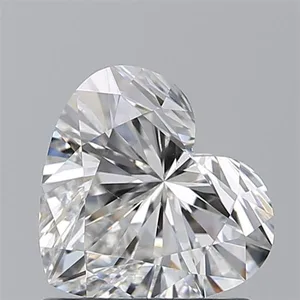
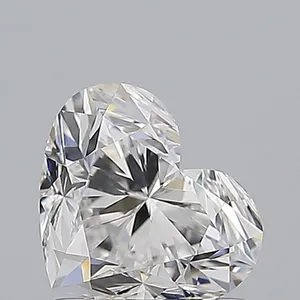
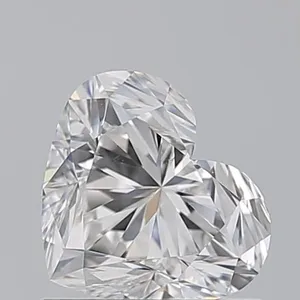
1 ct heart · Natural
about A$5,698
Typical price · based on 132 diamonds available through us
Listed now, at or under this price
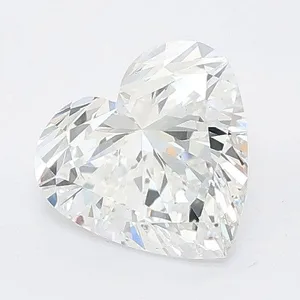
1 ct heart · Lab-grown
about A$1,527
Typical price · based on 104 diamonds available through us
Listed now, at or under this price
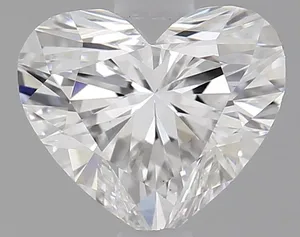
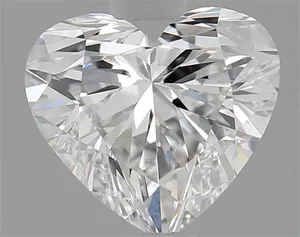
At this size, lab-grown costs about 75% less than natural.
Natural: E–F colour, VS2 clarity, excellent cut for rounds. Lab-grown: E colour, VS1 clarity, ideal cut for rounds. GST included.
Put it in an engagement ringTypical prices of the diamonds available through us, updated 10 October 2026. See every shape and size in our diamond price guide.
Compare other shapes
Heart sits in the elongated-brilliant family alongside pear and oval — same brilliant facet pattern, different outline. If you're weighing the heart against its closest cousins, read the Pear Buying Guide or the Oval Buying Guide. For a single-page side-by-side across all ten shapes, see our Diamond Shape Comparison. Or jump straight to our engagement ring designs when you're ready to choose a setting.
Common questions
Which symmetry issues to check in a heart cut?
Look for mismatched lobes (one bigger than the other), off-centre cleft (the notch at the top not centred over the point), and tilted point. GIA grades symmetry from Excellent down to Poor; on a heart, target Excellent or Very Good. Anything Good or below shows visible outline problems that no clarity or colour grade can compensate for.How big must a heart cut be to look right?
For engagement rings, 0.50ct is the practical minimum — below that the outline is too small to read clearly as a heart at arm's length. Pendants and earrings can work down to 0.30ct because the viewer is closer. Above 1.00ct the heart silhouette dominates the ring and the shape's romance really lands.Which setting flatters a heart shape?
The five-prong solitaire is the classic heart setting: one prong at the point, one straddling the cleft, and three around the lobes. Halo settings enlarge smaller hearts beautifully. Bezel settings are more architectural but tend to obscure the silhouette — a partial bezel wrapping the lobes is a good middle ground.Are lab-grown heart cuts good value?
Yes — lab-grown hearts are especially good value because the larger and more flexible rough supply makes heart-cutting more economical relative to pear. A heart cut carries a 5-15% premium over pear at the same specifications on natural inventory; that gap narrows on lab-grown, and you can afford the Excellent symmetry that matters most.