Melbourne CBD
Melbourne showroom
257 Collins Street, Level 3Melbourne VIC 3000
Email us before visiting Collins Street. Please wait for our email confirmation before coming in.
Arrange your visitMetals & Wedding Rings
An eternity ring is a band set with a continuous, or near-continuous, line of matched diamonds — traditionally given after marriage, most often for a wedding anniversary, to mark that the love keeps going rather than to start it. Unlike an engagement ring or a wedding ring, it isn't part of the proposal or the ceremony. The real decisions are the style (full, half or shared-prong) and how well the stones are matched — and it's worth knowing before you buy that a full-eternity band is the hardest ring style to resize later.
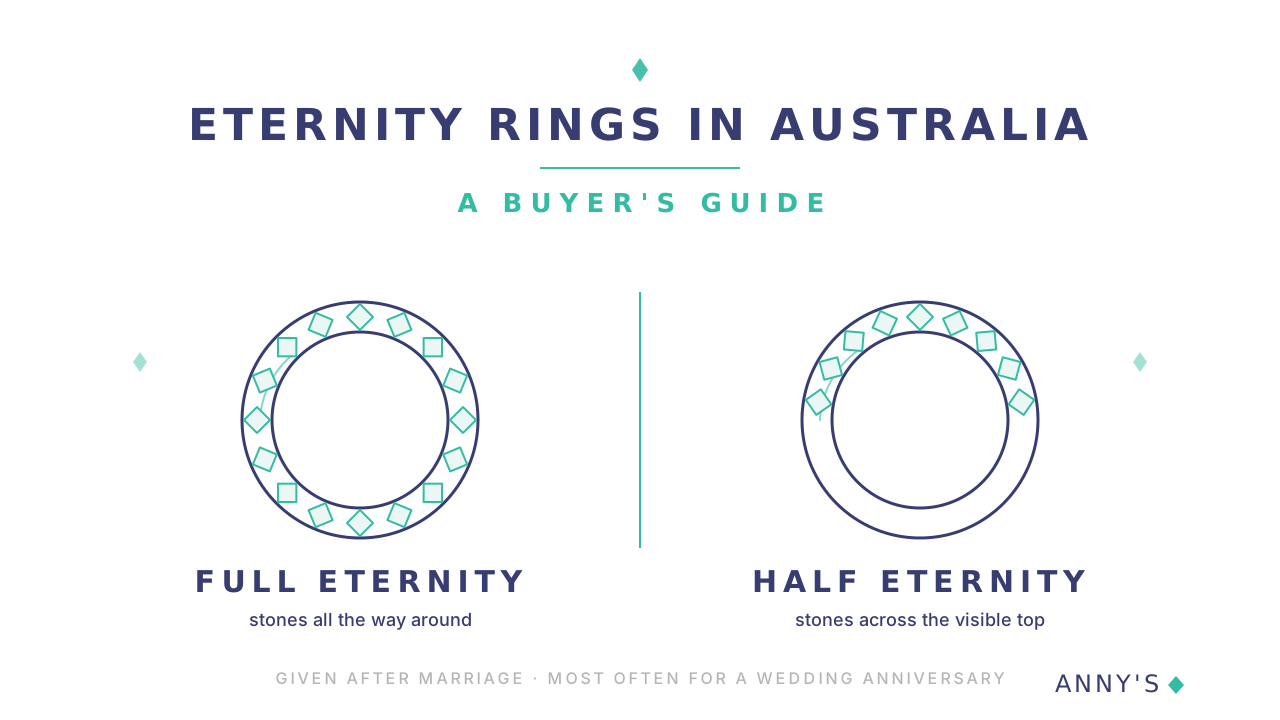
An eternity ring is a band set with diamonds (or another gemstone) running continuously, or almost continuously, around its circumference — a design meant to represent love with no beginning or end. An eternity ring is a distinct category from an engagement ring or a wedding ring, both in when it's given and what it means.
The idea has a genuinely interesting origin. The modern diamond eternity ring was created in the 1960s by the diamond company De Beers. The supply story behind it comes from the investigative journalist Edward Jay Epstein, who stated that De Beers had a secret agreement with the Soviet Union requiring it to buy 90–95% of the uncut gem diamonds produced by Russia — stones that were “often less than 0.25 carats” (Wikipedia, "Eternity ring," accessed 2026-07-25). Rather than stockpile the surplus, De Beers promoted jewellery set with many small diamonds, culminating in the eternity ring, which was aimed at “older, married women.” One campaign slogan, aimed at husbands, put it bluntly: "She married you for richer or poorer. Let her know how it's going."
That history explains why an eternity ring reads differently to an engagement ring. An eternity ring isn't proposing anything — it's a "we're still going" piece, given once the marriage is already underway.
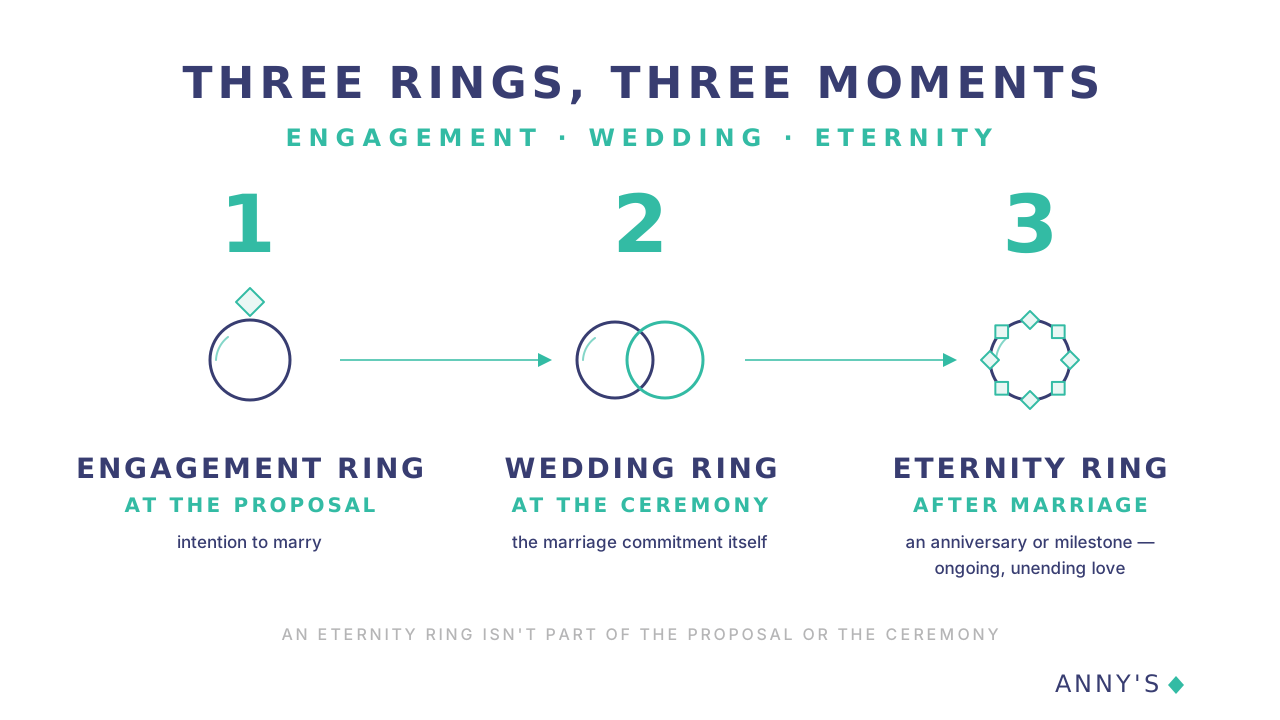
The three ring types differ in when they're given and what they mean, not just how they look. An engagement ring marks a proposal; a wedding ring is exchanged at the ceremony; an eternity ring is given afterward, to mark that the relationship is continuing.
| Ring type | When it's given | What it symbolises |
|---|---|---|
| Engagement ring | At the proposal | Intention to marry |
| Wedding ring | At the wedding ceremony | The marriage commitment itself |
| Eternity ring | After marriage — an anniversary or milestone | Ongoing, unending love |
Because it comes later, an eternity ring is often chosen with more freedom than an engagement ring. The centre-stone pressure is gone, and the focus shifts to the band as a whole — how the diamonds sit together, and how the piece wears day to day. You can browse our wedding and eternity bands to see the range.
 View full size
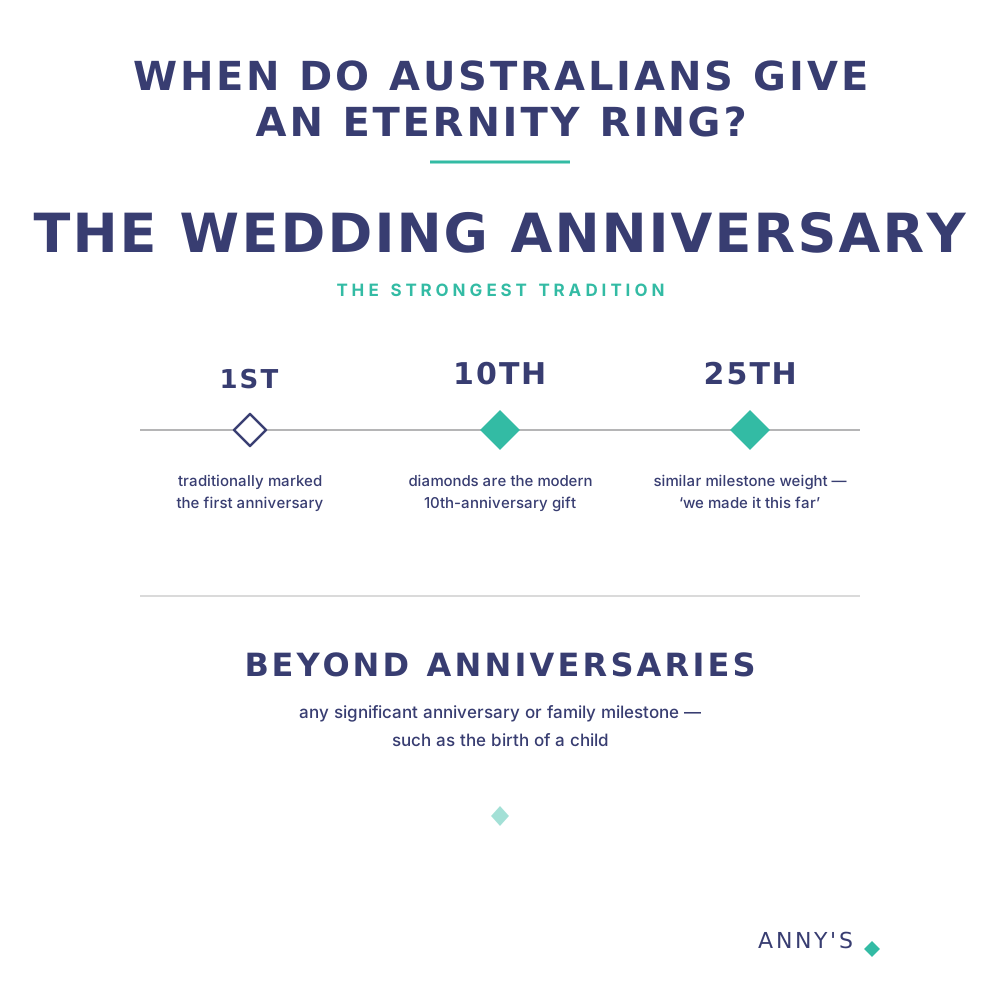
The most genuine occasion is a wedding anniversary — especially a milestone one, such as the 10th or 25th. You'll find plenty of confident claims online about which anniversary an eternity ring “traditionally” marks — the first, the tenth, the twenty-fifth — and they contradict each other, so we won't pretend there's a single settled tradition. In practice, Australian couples give and receive them for any significant anniversary or family milestone.
That timing isn't accidental. Diamonds are the modern gift material associated with a 10th wedding anniversary, which is part of why eternity rings tend to cluster around that milestone specifically, and a 25th anniversary carries similar "we made it this far" weight.
Beyond anniversaries, families also mark an eternity ring around other genuine milestones, such as the birth of a child. We'd rather be honest, though: the anniversary is the strongest tradition, so that's where we'd point you first if you're choosing the moment as much as the ring.
 View full size
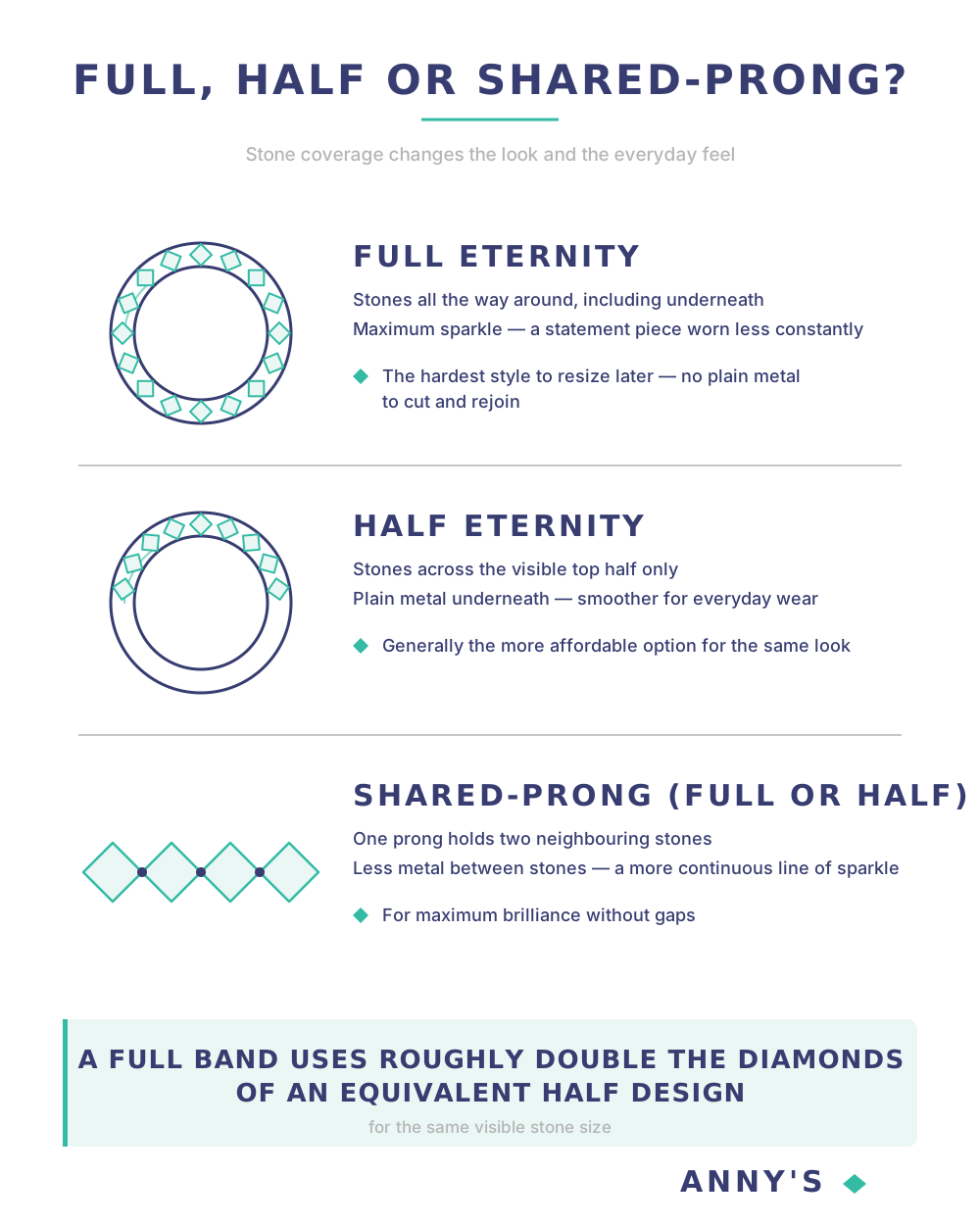
The three main eternity styles differ in how much of the band is set with stones, which changes both the look and the everyday feel of the ring. A full eternity band has diamonds set continuously all the way around, including underneath; a half eternity band has them set across the visible top only, with plain metal at the back; shared-prong is a setting technique — a single prong holding two neighbouring stones — that can be used on either style to make the line of diamonds look more continuous.
| Style | Stone coverage | Everyday feel | Typically best for |
|---|---|---|---|
| Full eternity | All the way around, including underneath | Stones can be felt against the finger and neighbouring fingers | Maximum sparkle; a statement piece worn less constantly |
| Half eternity | Across the visible top half only | Plain metal underneath — smoother, more comfortable | Everyday wear, especially alongside other rings |
| Shared-prong (full or half) | Either style, with stones set closer together | Less visible metal between stones, more continuous sparkle | Buyers who want maximum brilliance without gaps |
A full eternity band also uses roughly double the diamonds of an equivalent half design for the same visible stone size, which is one reason half eternity rings are generally the more affordable option.
 View full size
Worth knowing before you buy: a full-eternity band is the hardest ring style to resize later, because there's no plain metal left to cut and rejoin. It isn't impossible — it just takes real bench skill and patience. If resizing is something you're weighing up now, our full guide to resizing a wedding or eternity ring covers it properly; we won't repeat that whole answer here.
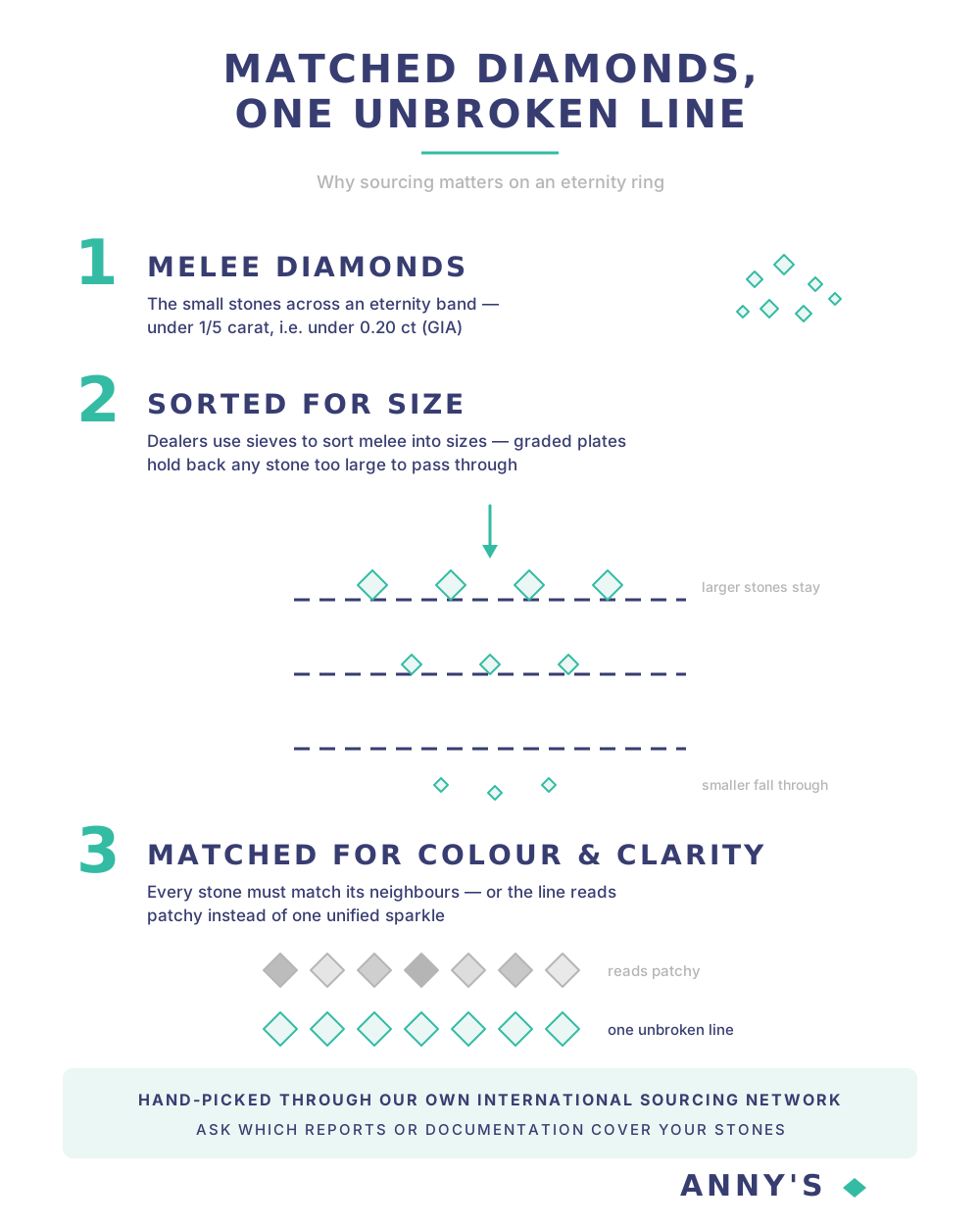
Matched-diamond sourcing matters because an eternity ring lives or dies on consistency: every stone has to sit alongside its neighbour and read as part of one unbroken line, not a patchwork of slightly different diamonds. That's a genuinely different job to choosing a single centre stone, because the eye compares each diamond to the one beside it, all the way around the ring.
The small diamonds used across an eternity band fall into a category the Gemological Institute of America (GIA) calls “melee.” GIA “defines melee (pronounced meh-lee) as small diamonds and gemstones weighing less than 1/5 carat (ct)” — under 0.20 ct — while adding that “size ranges vary from country to country and from one segment of the trade to another” (GIA, "Melee: Building Blocks of Contemporary Design," accessed 2026-07-25). To sort them for consistent size, GIA notes that “dealers may use sieves” — graded plates that hold back any stone too large to pass through.
But size is only half the job. Every stone also needs to match its neighbours in colour and clarity, or the line of diamonds looks patchy instead of one continuous, unified sparkle.
This is where Anny's genuinely earns its keep. We hand-pick stones through our own international sourcing network rather than drawing from one fixed batch. Our in-house gemmologist (FGAA-accredited through the Gemmological Association of Australia) anchors the stone-quality decisions on every piece we set. Small accent diamonds may be documented as part of the finished piece rather than individually graded. Ask what the available documents cover. You can browse our hand-picked diamonds and available grading reports.
 View full size
Both — an eternity ring can be chosen ready-made, or designed from scratch to your own vision. Because Anny's designs, sources stones and sets everything under one roof at our Frankston workshop, a custom eternity ring goes through the same process as any bespoke piece.
In practice, that means three plain steps: we design your piece in CAD and send you detailed images; we 3D-print a wax model so you can see and adjust the design in person, with small changes usually made within the hour (we'll confirm timing for larger changes); then a specialist casting house casts it, and we set and polish the finished ring in-house. You can read the full breakdown on our custom design process page.
Ready to Ship pieces dispatch from our warehouse in 1–3 business days; from CAD sign-off, a custom eternity ring takes approximately 3–4 weeks, subject to design complexity and workshop capacity.
In practice, yes — "eternity ring" and "anniversary ring" are usually the same piece described two ways: one names the design (a continuous line of matched diamonds), the other names the occasion it's most often given for (a wedding anniversary).
Most people do, stacking it alongside the engagement and wedding rings on the same finger, though there's no fixed rule. Some prefer wearing it on the right hand instead, especially with a full-eternity design that's less practical to stack.
Yes — sapphires and rubies are common alternatives, and Anny's genuinely specialises in coloured-gemstone rings alongside diamonds. A coloured stone can also make matching easier in some respects, since subtle tone variation reads differently to diamond colour grading.
It depends entirely on the ring size, stone size and whether it's a full or half design — there's no fixed number. A larger ring size or smaller stones simply means more diamonds that all need to match.
If you're thinking about an eternity ring — ready-made or designed from scratch — you're welcome to Email us about visiting our Frankston workshop, or come in and see the range in person.
Typical engagement and bridal ring turnaround: 3–4 weeks from CAD sign-off. We also have 2-week and 48-hour options for engagement and bridal rings. Get in touch and we'll help find an option that works for your timeframe.
Made personal, at Anny's
Melbourne CBD
Email us before visiting Collins Street. Please wait for our email confirmation before coming in.
Arrange your visitOur Frankston home
Visit us to talk through your ideas, explore designs and find your perfect fit.
Explore our Frankston showroomTypical engagement and bridal ring turnaround: 3–4 weeks from CAD sign-off. We also have 2-week and 48-hour options for engagement and bridal rings. Get in touch and we'll help find an option that works for your timeframe.
Typical repair turnaround: 1 to 7 business days, depending on complexity and customer urgency
Anny's Manufacturing JewellersABN 88 447 171 579