Wedding rings · Fit guide
Curved wedding bands: getting a flush fit against your engagement ring
A curved wedding band has a dip or notch shaped around your engagement ring's setting, so the two rings sit flush instead of leaving a gap. Whether you need one depends on how wide your setting is and how low it sits. Bring your engagement ring in and we'll check which band shapes will sit flush against it. If none from our range nests neatly, we shape a band to fit in our Frankston workshop.

Why a straight band can leave a gap
The gap comes from the setting, the metalwork that holds your stone. When the setting is wider than the band beneath it, a straight wedding band bumps into it before the two bands meet, leaving a sliver of finger showing.
A curved band has a dip shaped around the setting, so its shoulders sit flush against the engagement ring on both sides. A gentle curve is often called a contour or shadow band; a sharper cut-out for an angular setting is a notched band.
Seen from above, on the finger
Straight band
It stops against the setting, so a gap shows on either side.
Curved band
The dip follows a round halo, so the bands meet all the way along.
V-shaped band
A sharper V suits the point of a marquise or pear.
Height matters less than you might think
What decides the fit is your setting's profile: its shape seen from the side. With open space under the stone, a straight band can often slide underneath and sit flush. A low setting, a halo or a hidden halo usually leaves no room.
Why the setting's profile matters
Low setting
The setting overhangs close to the finger, so a straight band can't tuck under it.
Higher setting
There's room beneath the stone, so a straight band may slide under and sit flush.
Stone shape plays a part too. Oval, pear and marquise stones usually sit lengthways along the finger, so they overhang further than a round stone of the same weight. That is why they so often pair with a V or a deeper curve. See our solitaire guide for high and low mountings, and our hidden halo guide for a setting that often needs a curve.
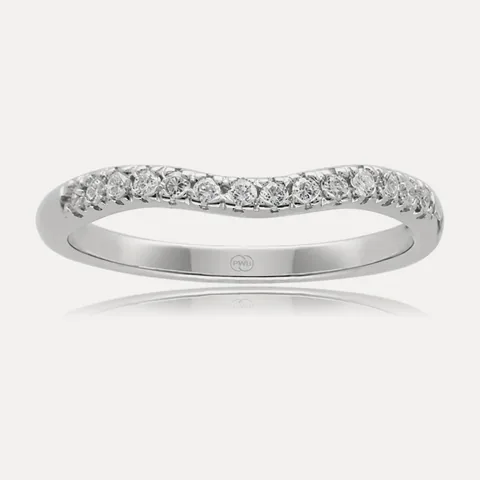
Four curve styles and the rings they suit
Our range has a curve for most engagement rings. Each band is made in your choice of metal and size, and our jewellers can check the fit beside your engagement ring.
-
-
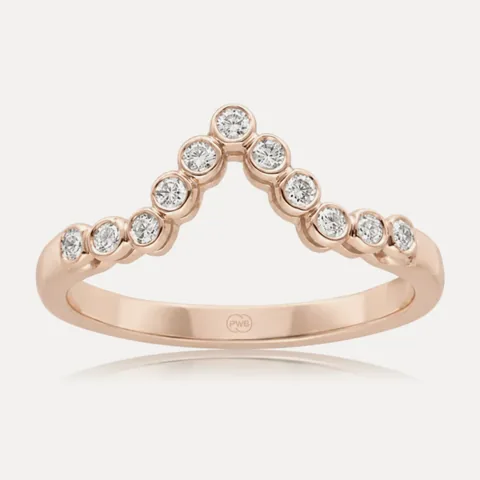
-
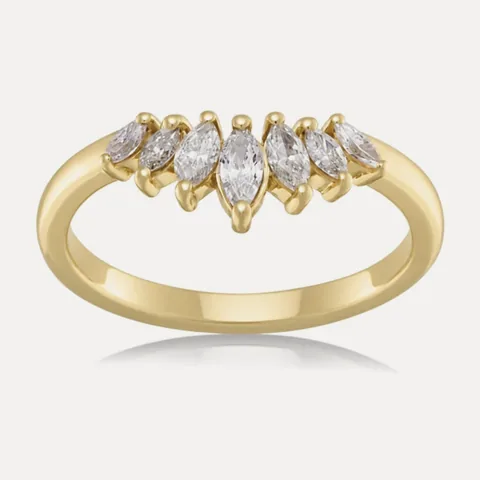
-
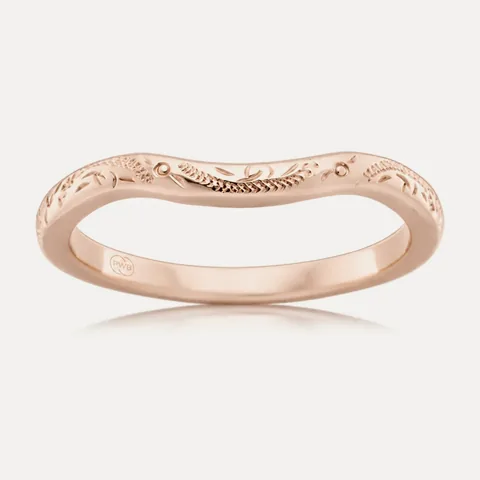
Engraved curve
A slim plain curve with a hand-engraved pattern, for a quieter look.
See every shape in our women's wedding rings, or browse the full wedding ring collection.
Ready-made curve or custom-shaped band?
A curve from our range suits many engagement rings. A band shaped to your own ring makes more sense when:
- None of the ready-made curves closes the gap against your ring.
- Your setting is unusual, such as a large halo, a cluster or a two-stone toi et moi.
- You want the band to match your engagement ring's metal, stones and details exactly.
Because we design and finish bands in our own workshop, we can shape one around your ring instead of fitting your ring to a stock shape.
How we fit a band to your ring
- Bring your engagement ring in
Visit our Frankston workshop, where walk-ins are welcome. The first design consultation is free.
- Check the profile
We look at your setting from every side, work out which band shapes will sit flush and check the metal match.
- Scan and design
For a custom band, our Artec Micro 3D scanner records your ring's exact profile and we design the band around it in CAD. A $500 design fee starts the project and comes off the final price.
- Try the 3D-printed model
You see a printed model against your ring before any metal is cast. Small changes are usually made within the hour.
- Cast, finished and fitted
A specialist casting house casts the band in 9ct, 14ct or 18ct gold or platinum. We then finish it in our workshop and check it against your ring. Allow approximately 3 to 4 weeks from CAD sign-off, depending on complexity and workshop capacity.
Custom work is paid 80% at CAD sign-off and 20% on completion. For the full sequence, see custom-made jewellery or how a custom engagement ring is made.
Match the metal as carefully as the curve
The mistake we see most isn't the curve. It's a band whose metal quietly doesn't match. Gold of the same colour looks different at different purities: 18ct is 75% gold and 9ct is 37.5%, and the extra alloy makes 9ct yellow paler. Side by side on one finger, that shows every day.
White metals have their own version. White gold is rhodium plated for its bright white, and its shade can shift as the plating wears. Platinum is naturally white with a slightly warmer tone; it develops a soft patina rather than changing colour.
Before you order a band, check:
- The purity stamp inside your engagement ring, such as 375 for 9ct or 750 for 18ct.
- Whether a white gold ring is rhodium plated. Re-plating both rings together keeps them matched, and rhodium plating is a separate paid service.
- That any contrast is deliberate. Yellow beside white, or rose beside yellow, can look lovely when it's planned.
For more detail, compare 9ct and 18ct gold or platinum and 18ct white gold.
Matching, contrasting or straight: three ways to pair
None of these is wrong. Each gives up a little of one thing for another.
- You want the two rings to read as one pieceMatching metal and a matching curve
- You want a deliberate two-tone look without losing the fitA contrasting metal, shaped the same way
- You'd rather wear the band alone, stack it later or resize it easilyA straight band, accepting a possible gap
Should the rings be soldered together?
That's a separate choice from the curve, and most couples make it later, if at all. Soldering joins the two rings permanently, so they can't twist out of line or rub. A shaped band stays a separate ring that simply sits flush.
| What changes | Soldered together | Separate shaped band |
|---|---|---|
| Alignment | Always lined up | Can twist a little on the finger |
| Wearing one ring alone | Not possible | Either ring, any time |
| Resizing | Resized together, as one wider band | Each ring resized on its own |
| Wear between the rings | None | Can rub over the years; mention it at your next clean and polish |
Frequently asked questions
Can you shape a band to fit a ring I didn't buy from Anny's?
Yes. Bring the ring in, wherever it was made. We scan it and design the band around its actual shape, exactly as we would for one of ours.
Will a curved band still fit if I change my engagement ring's setting later?
Not reliably. The band is shaped to your setting as it is today, so a new head or a different stone shape can change how flush it sits. Bring both rings in and we'll check them together.
Can an existing straight band be reshaped into a curved one?
Sometimes. It depends on how much metal the band has to work with, so we'd need to see your ring before promising either way.
Bring your engagement ring in
Visit our Frankston workshop and we'll check which bands will sit flush against your ring. Walk-ins are welcome.
For our Collins Street showroom, please email us first and wait for our confirmation before visiting.