The short answer
GIA and IGI both provide independent information to help you choose a diamond. For lab-grown diamonds, IGI reports identify the origin and give individual quality grades; GIA’s current reporting format differs. Read the actual report, compare the stone’s appearance and consider your budget. Anny's sells diamonds with reports from both laboratories, including many IGI-graded lab-grown diamonds.

What is the difference between GIA and IGI?
GIA stands for Gemological Institute of America; IGI stands for International Gemological Institute. Both examine natural and laboratory-grown diamonds.
For natural diamonds, compare the actual grades, the stone’s appearance and the price. Ask your jeweller to explain any differences between reports.
| What you are comparing | GIA | IGI |
|---|---|---|
| Natural diamonds | Offers reports recording the 4Cs: carat weight, colour, clarity and cut information appropriate to the shape. | Also offers natural-diamond reports recording the 4Cs and identifying characteristics. |
| Colourless to near-colourless lab-grown diamonds | Current service uses an overall Premium or Standard quality assessment. Older reports may show individual colour and clarity grades. | Continues to provide individual colour, clarity and other grading details. |
| Cut information for shapes such as ovals | Standard reports provide polish and symmetry assessments, without an overall cut grade. | Offers fancy-shape cut assessment; check the actual report for the grade provided. |
| Checking the document | Use GIA's official Report Check. | Use IGI's official Verify Your Report tool. |
Scroll the table to compare both laboratories.
See the laboratories' own descriptions of GIA natural-diamond reports, GIA lab-grown services, IGI diamond reports and IGI cut assessment.
Is IGI a good choice for a lab-grown diamond?
Yes. IGI's lab-grown reports give you practical details to compare: the diamond's identity, shape, measurements, carat weight, colour and clarity, along with relevant cut information. Having individual grades is useful when you are narrowing a shortlist. IGI's report guide explains these fields.
Use those grades to shortlist, then compare the actual stones. The same care applies to a diamond with a GIA report.
Read the comments as well as the headline grades. IGI says details of how a diamond was grown and any treatments can be included upon request. Ask your jeweller to check what information is available. IGI lab-grown reporting
What changed in GIA's lab-grown reports?
Since 1 October 2025, GIA’s colourless-to-near-colourless lab-grown service has used overall Premium or Standard assessments. IGI reports give individual quality grades. A GIA category cannot be translated into one exact IGI colour and clarity grade.
Older GIA lab-grown reports remain valid. Check the document's date and service type before assuming what it should contain. GIA's confirmation
GIA service details and assessment criteria
The current GIA service covers loose stones of at least 0.15ct; GIA has separate services for coloured lab-grown diamonds. GIA service details
Premium and Standard reflect criteria across colour, clarity and finish, with cut included for round brilliants. Premium requires all its criteria to be met. Standard covers a broader combination of characteristics, rather than one exact colour-and-clarity pairing. Stones below the minimum Standard criteria do not receive an assessment. GIA's launch announcement
How to compare two diamonds fairly
Start with the same diamond type: natural against natural, or lab-grown against lab-grown. Then compare similar shapes and weights, and work through these points:
- Read the actual reports. A search listing summarises selected fields. The report gives you the laboratory's wording, measurements and any relevant comments.
- Check the grading system. Reports from the same laboratory and service can be easier to compare. Across laboratories, ask about the format and criteria; do not assume a fixed grade adjustment. Even matching grades do not make two stones identical.
- Consider the shape and proportions. Measurements help explain the size you will see when looking down at the ring. Cut reporting also varies: A standard GIA report does not provide the same overall cut grade for an oval as it does for a standard round brilliant. Polish and symmetry are separate assessments. GIA on fancy-shape cut grading
- Look at the diamond in motion. Review a clear video or inspect the stone in different lighting, looking at brightness, transparency and the pattern of light and dark areas. For elongated shapes, discuss any prominent bow-tie shadow across the centre. A still photograph cannot show every viewing angle. GIA's oval-diamond guide explains why viewing the stone matters.
A report is valuable evidence, but it cannot decide which outline, proportions or sparkle you enjoy most. Bring your shortlist into the design conversation so the diamond and setting can be considered together.
What do GIA and IGI reports look like?
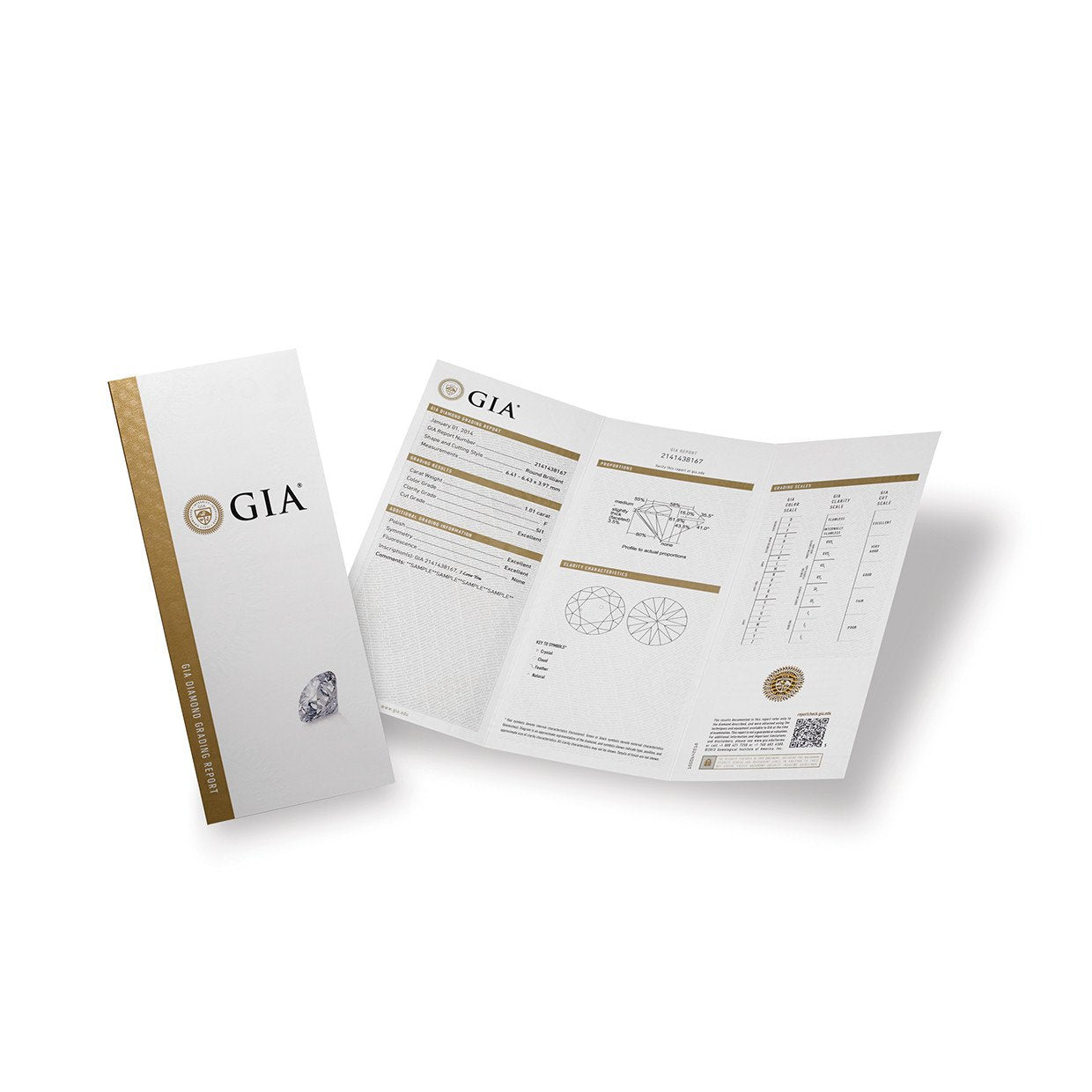
Often called diamond certificates, these reports record the laboratory's findings. The photos below show a GIA natural-diamond report and an IGI jewellery-report example. They cover different report types and are not a direct comparison of grades.
GIA natural-diamond report
IGI jewellery-report example
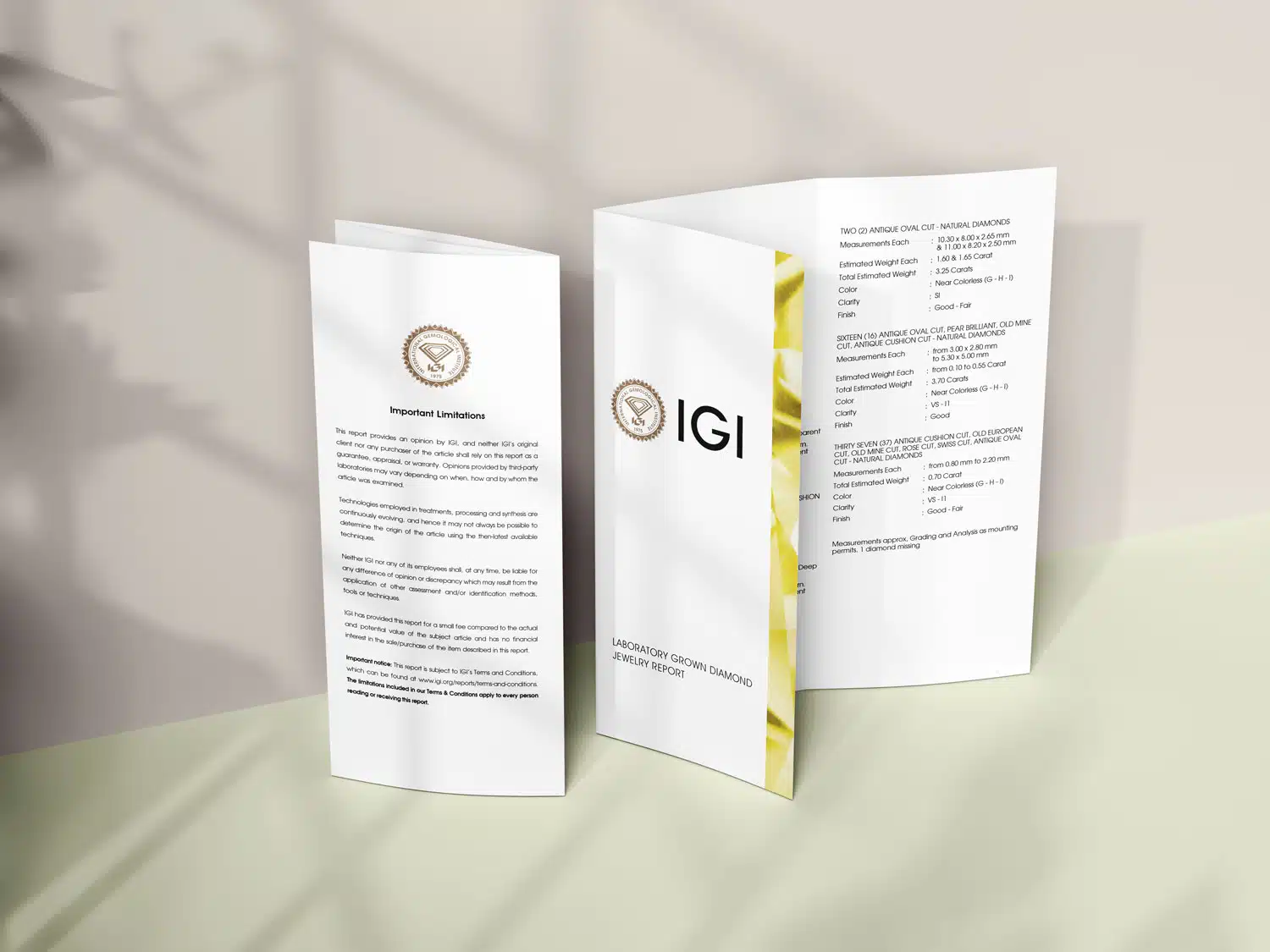
When checking your own report, start with the diamond's identity, report number, measurements and grading details, then read the comments. GIA's current colourless-to-near-colourless lab-grown assessment has a different layout from the natural-diamond example above.
Where is the report number on the diamond?
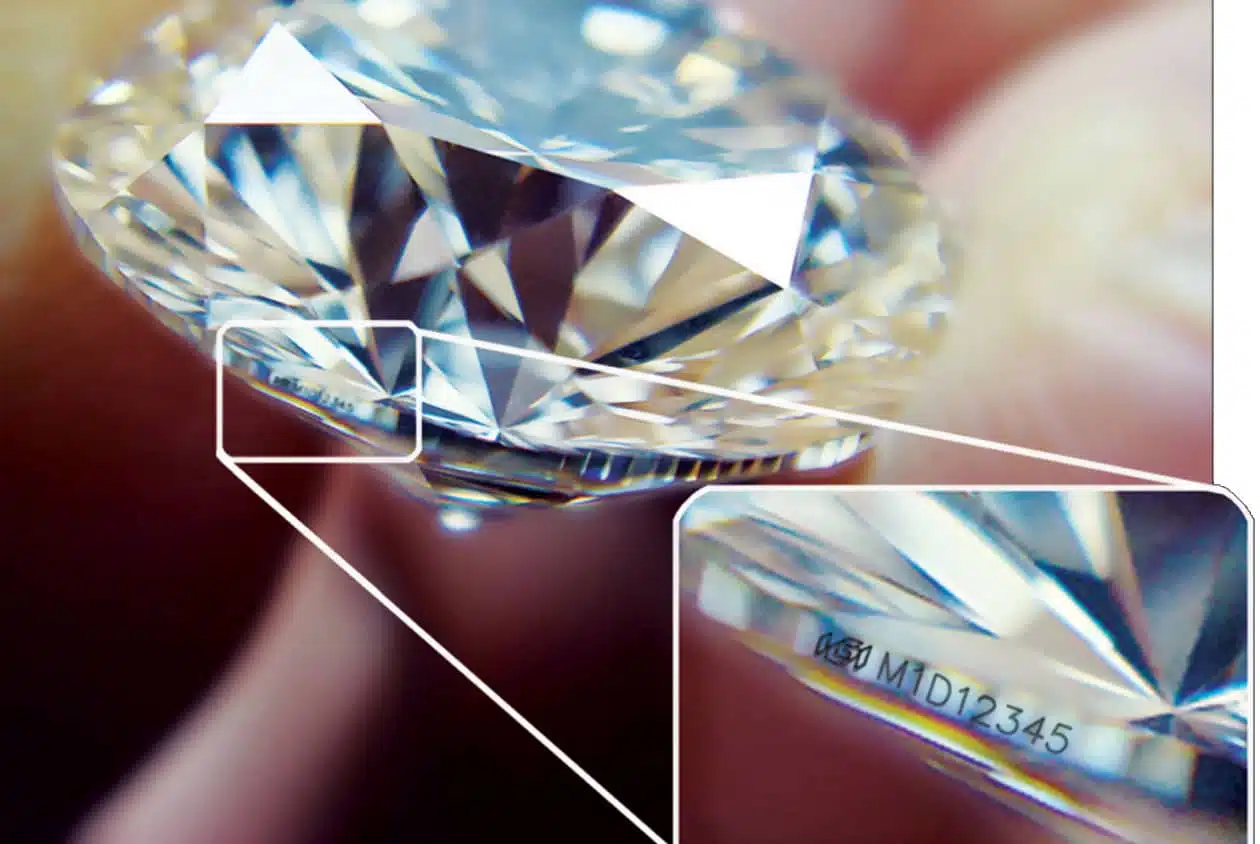
A report number may be laser-inscribed on a diamond’s girdle, the narrow edge around its widest part. A jeweller can read it under magnification and compare it with the report. Both GIA and IGI offer this service. IGI explains its Laserscribe service.
Inscription is included with some report services and optional with others, so check the individual report. GIA's current colourless-to-near-colourless lab-grown service inscribes “Laboratory-Grown” and the quality assessment number. GIA natural-diamond services and lab-grown services explain the difference.
How to check a GIA or IGI report
Check the record, then match it to the diamond.
- Enter the report number through GIA Report Check or IGI Verify Your Report.
- Compare the returned details with the document supplied, including the stone's natural or laboratory-grown description, measurements and grading information.
- Ask your jeweller to match the stone to the report. Where a laser inscription is present, compare it under suitable magnification alongside other identifying features.
Finding a genuine report online confirms that the laboratory has that record. It does not, by itself, authenticate the diamond in front of you. An inscription is another useful check, rather than the entire identification process. GIA's identification case notes illustrate why matching matters.
Compare current prices alongside the reports
Use Anny's current natural-diamond listings or lab-grown diamond listings to compare available stones. Keep the diamond type, shape, weight and quality details in view when assessing a price difference.
A loose-diamond price is for the stone; the setting, metal and making of your ring need a separate quote. Ask us about availability and viewing arrangements for a shortlisted diamond. An online listing does not mean the stone is physically in either showroom.
A few common questions
How should I compare reports for natural diamonds?
Both GIA and IGI grade natural diamonds. Compare the actual reports, the appearance of each stone and the asking prices. Check which cut information is provided for your chosen shape, and ask your jeweller to explain any differences before deciding.
Is a grading report the same as a valuation?
No. A grading report describes the diamond's gemmological characteristics. A valuation assigns a monetary value for a stated purpose. GIA specifically calls its documents reports, rather than certificates, and does not put an appraisal value on them. GIA's explanation
Choose your diamond with Anny's
Send us links to the diamond listings or copies of the reports you are considering. We can explain the details and discuss how each stone could work in your custom-made ring.
Frankston: 92 Young Street. Walk-ins welcome; no appointment required. Monday–Friday 10am–5pm and Saturday 10am–3pm.
Melbourne CBD: Level 3, 257 Collins Street. Email us before visiting Collins Street for engagement-ring and wedding-ring consultations. Please wait for our email confirmation before coming in. Remodelling consultations take place at our Frankston workshop.
Email Anny's at info@annys.com.au with your shortlist or to arrange a Melbourne CBD appointment.