What does 375 mean on gold?
It means 9 carat gold: 375 parts in every 1,000 are pure gold, or 37.5%.
Gold stamp chart
Gold stamps (often called hallmarks), from lowest to highest purity.
| Stamp | Carat | Pure gold |
|---|---|---|
| 333Also: 8K · 8ctThe German minimum for gold after 1884. | 8 ct | 33.3% |
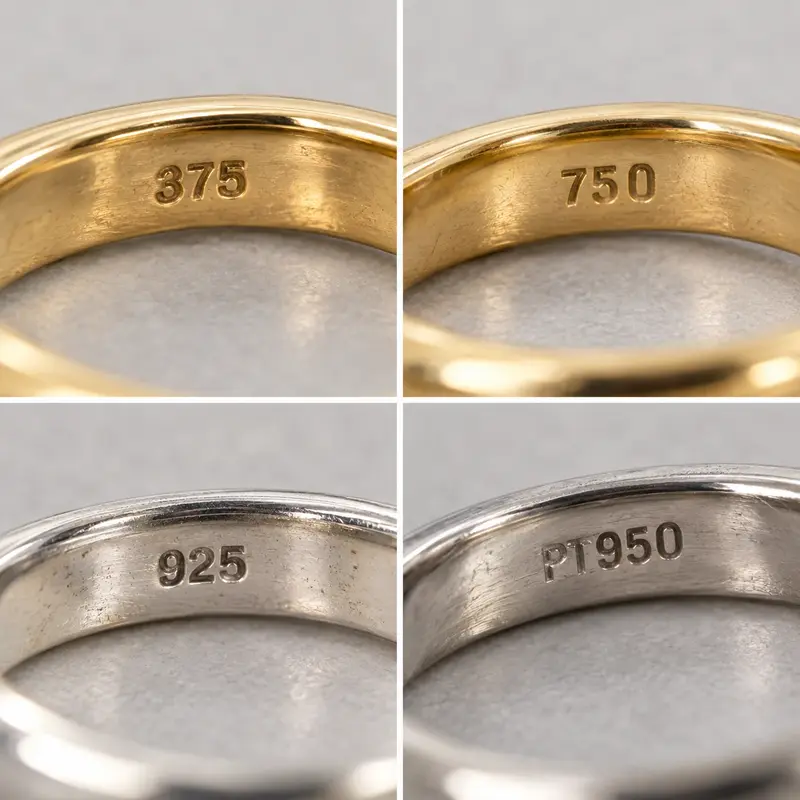
| 375Also: 9K · 9ct · 9KTCommon in Australian and UK jewellery. | 9 ct | 37.5% |
| 417Also: 10KHistorically the US minimum for gold. | 10 ct | 41.7% |
| 500Also: 12K | 12 ct | 50% |
| 585Also: 583 · 14K · 14ct · 14KTOlder pieces may say 583. | 14 ct | 58.5% |
| 750Also: 18K · 18ct · 18KT | 18 ct | 75% |
| 833Also: 20K | 20 ct | 83.3% |
| 875Also: 21K | 21 ct | 87.5% |
| 916Also: 917 · 22K · 22ct · 22KT | 22 ct | 91.6% |
| 958Also: 23K | 23 ct | 95.8% |
| 999Also: 990 · 999.9 · 24K · 24ct990 means 99.0%. | 24 ct | 99.9% |
Silver, platinum and palladium stamps
| Stamp | Metal | Purity |
|---|---|---|
| 800The German minimum for silver after 1884. | Silver (800) (Silver) | 80% |
| 925Also: Sterling · STER | Sterling silver (Silver) | 92.5% |
| 958 | Britannia silver (Silver) | 95.8% |
| 999Also: Fine silver | Fine silver (Silver) | 99.9% |
| PT850Also: Pt850 | Platinum (850) (Platinum) | 85% |
| PT900Also: Pt900 | Platinum (900) (Platinum) | 90% |
| PT950Also: Pt950 · 950 Plat · PLAT | Platinum (950) (Platinum) | 95% |
| PT999Also: Pt999 | Fine platinum (Platinum) | 99.9% |
| PD500Also: Pd500 | Palladium (500) (Palladium) | 50% |
| PD950Also: Pd950 | Palladium (950) (Palladium) | 95% |
Stamps that mean it isn’t solid
These marks mean a layer of gold over another metal. The carat beside them describes only that layer.
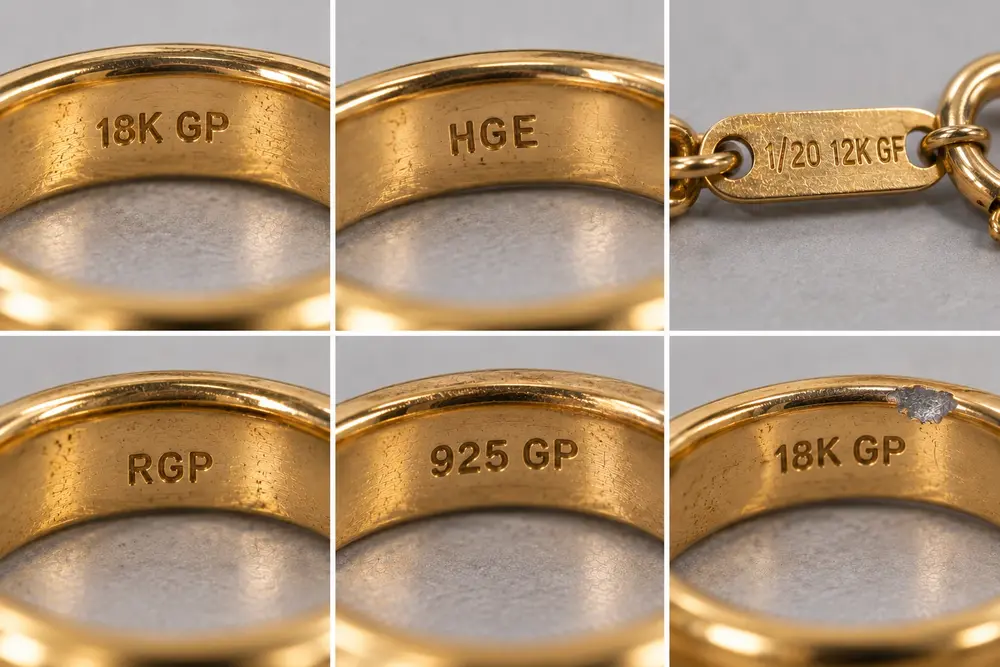
GP · GEP · 18K GP · Gold plated — Gold plated
A thin layer of gold over another metal. A carat beside GP, as in "18K GP", describes the plating only, not the piece.
Australian Standard (voluntary) minimum: 585 (14ct) gold, at least 0.5 microns thick.
HGE — Heavy gold electroplate
A thicker plated layer. Under US rules: gold of 10 carat or finer, at least 2.5 microns thick.
GF · 1/20 12K GF · Gold filled — Gold filled
A layer of gold bonded to a base metal. Under US rules the layer is at least 1/20 of the weight: "1/20 12K GF" is a 12 carat layer making up 1/20 of the piece.
Australian Standard (voluntary) minimum: 375 (9ct) gold, at least 5 microns thick.
RGP · 1/10 Rolled gold · Rolled gold — Rolled gold plate
Like gold filled, but a thinner bonded layer. The fraction says how much of the weight is gold alloy.
Australian Standard (voluntary) minimum: 375 (9ct) gold, at least 3 microns thick.
Gilt — Gilt
A very thin gold coating.
Australian Standard (voluntary) minimum: 585 (14ct) gold, under 0.5 microns thick.
Vermeil — Vermeil
Sterling silver plated with gold, so the piece is usually also stamped 925. Under US rules: gold of 10 carat or finer, at least 2.5 microns thick.
Reading a stamp
- Number stamps are parts per 1,000 of the precious metal; carat stamps (ct, K or KT) are parts in 24.
- Look inside a ring’s band, or near the clasp on a chain or bracelet. Stamps are small and can wear.
Not sure it’s real? We can acid test it
Hallmarking isn’t compulsory in Australia, so a stamp is only the maker’s claim and can be wrong. Bring the piece in and we’ll acid test it to check the metal: A$30 per piece.
How the test works
- We rub the piece gently on a black touchstone, leaving a thin streak of metal on the stone.
- Beside it, we rub test needles of known carat, such as 10ct, 14ct and 18ct.
- Following the test kit’s instructions, we apply testing acid and compare how the piece’s streak reacts beside the known samples.
- We use those comparisons to estimate the gold’s carat, checking with another acid or reference needle when needed.
The test reads the surface of the metal, so tell us if you think a piece may be plated.
Get in touch to bring a piece in
Need to know what it’s worth, too? Our valuations come with a signed written report for insurance or your records.
Next steps
Choosing a metal for a ring? Compare 9ct, 18ct gold and platinum.
Want to know what your jewellery is worth? See our jewellery valuations.
Have old gold you no longer wear? We can remake it into something new.
Common questions
What does 585 mean on gold?
It means 14 carat gold: 585 parts in every 1,000, or 58.5%, are pure gold. Strictly, 14 ÷ 24 is 58.3%, but 585 is the standard stamp; older pieces may say 583.What does 750 mean on gold?
It means 18 carat gold: 75% pure gold. 18 ÷ 24 is three quarters, so 750 and 18ct are the same standard.What does 925 mean on jewellery?
It means sterling silver: 92.5% pure silver. A gold-coloured piece stamped 925 is usually gold-plated silver, gilt or vermeil, not solid gold.Is 375 gold real gold?
Yes. 375 is solid 9 carat gold: 37.5% pure gold mixed with other metals all the way through. A plated piece should carry a mark such as GP or GF instead, but a stamp is only the maker’s claim, so have it acid tested if in doubt.Does a stamp prove my jewellery is real?
No. Hallmarking isn’t compulsory in Australia, so a stamp is only the maker’s claim and can be wrong. Bring the piece in and we can acid test it for A$30 to check the metal.
Sources
- Jewellers Association of Australia: Metals (AS 2140-2008 fineness; AS 2335-2008 plated, rolled and filled minimums)
- Jeweller Magazine (2012): India mandates hallmarking: what about Australia?
- legislation.gov.uk: The Hallmarking (International Convention) Order 2002, as amended
- US Federal Trade Commission (16 CFR § 23.3): Guides for the Jewelry Industry: misuse of the word "gold"
- US Federal Trade Commission (16 CFR § 23.4): Guides for the Jewelry Industry: misuse of the word "vermeil"
- US Federal Trade Commission (16 CFR § 23.5): Guides for the Jewelry Industry: misuse of the word "silver"
- US Federal Trade Commission (16 CFR § 23.6): Guides for the Jewelry Industry: platinum group metals
- Wikipedia: Fineness
- GIA: Bench tip: use the touchstone method for testing karat gold
- 911Metallurgist: Gold Purity Testing (touchstone and acid)
Reviewed