Engagement rings / choosing your stone
Moissanite vs diamond: which should you choose?
An Australian guide to sparkle, everyday wear and choosing a stone within your ring budget.
The short answer
Choose moissanite if you enjoy its colourful rainbow flashes. Choose diamond if you prefer its appearance and want the stone itself to be diamond; compare natural and lab-grown options for your budget. Both can suit regular ring wear, but neither is unbreakable. Choose a suitable setting and compare complete-ring prices.
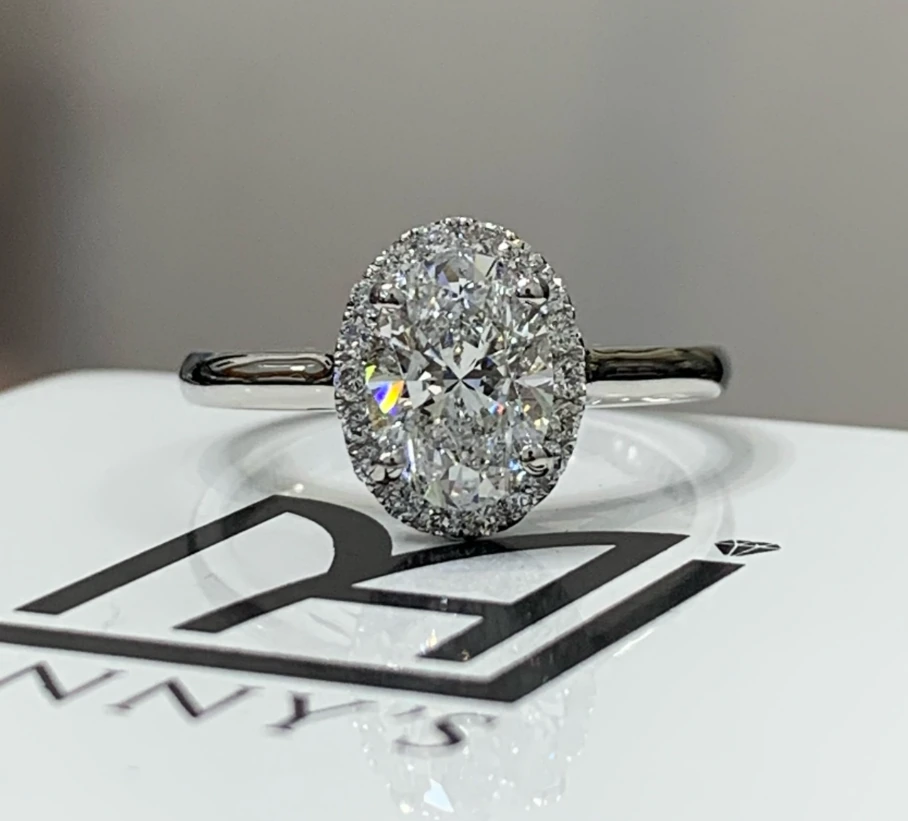
An oval centre stone framed by a halo on an Anny's display.
Image supplied by Anny's Manufacturing Jewellers.
The differences at a glance
| What matters | Moissanite | Diamond |
|---|---|---|
| The stone | A different gemstone from diamond. Jewellery moissanite is lab-created. | Natural and lab-grown options are both diamond. |
| The look | Usually more noticeable rainbow flashes. | Coloured flashes and white sparkle. Cut affects the appearance. |
| Daily wear | Durable enough for regular ring wear; protect it from hard knocks. | Highly scratch resistant; exposed edges and points can still chip. |
| Your budget | Ask for a quote in your preferred shape and dimensions. | Compare natural and lab-grown options, including the setting cost. |
Diamond and simulant properties compared
Lab-grown and natural diamonds share essentially the same chemical, physical and optical properties. Cubic zirconia, moissanite, white sapphire and YAG are different materials that can resemble diamond.
Swipe or scroll sideways to compare all properties.
| Material | Formula | Crystal system | Refractive index | Dispersion | Hardness (Mohs) | Relative density |
|---|---|---|---|---|---|---|
| Lab-grown diamond | C | Cubic | 2.42 | 0.044 | 10 | 3.52 |
| Natural diamond | C | Cubic | 2.42 | 0.044 | 10 | 3.52 |
| Cubic zirconia | ZrO₂ + stabilisers | Cubic | 2.15–2.18 | 0.058–0.066 | 8–8.5 | 5.56–6.00 |
| Moissanite | SiC | Hexagonal* | 2.65–2.69 | 0.104 | 9.25 | 3.22 |
| White sapphire | Al₂O₃ | Trigonal | 1.762–1.770 | 0.018 | 9 | 4.00 |
| YAG | Y₃Al₅O₁₂ | Cubic | 1.833 | 0.028 | 8.25 | 4.55 |
The first two rows share the same typical values. Cut, clarity and other individual features still affect how a diamond looks. These numbers are material properties, not a sparkle rating.
Approximate reference values. *Moissanite figures refer to hexagonal 6H material; other crystal forms can differ. Relative density means specific gravity. YAG is yttrium aluminium garnet. GIA comparison and reference values.
How to read these values
Moissanite is silicon carbide; diamond is crystalline carbon. Jewellery moissanite is laboratory-created. A lab-grown diamond is diamond, with essentially the same chemical, physical and optical properties as a natural diamond. Its growth origin is different. GIA: natural and laboratory-grown diamonds, GIA: moissanite research.
The chart also includes cubic zirconia, white sapphire and YAG (yttrium aluminium garnet) for context. These are different materials from diamond.
Reading the chart: refractive index describes how strongly light bends; dispersion relates to coloured fire. Higher optical values do not guarantee a more beautiful stone. Specific gravity compares density with water and has no units. Hardness measures scratch resistance, not resistance to breaking; the Mohs scale is not evenly spaced.
These are reference values, not quality grades for individual stones. *Moissanite figures are for 6H hexagonal material; other crystal forms exist. The paired refractive indices reflect double refraction. GIA: material-property comparison, GIA: sapphire properties, IUCr: crystal-system terminology.
Moissanite is also doubly refractive: light can travel through it as two rays. Under magnification, this can produce doubled-looking internal facet edges. It is a material property, not a defect, and it is separate from the amount of fire. A photograph alone is a poor way to establish a stone's identity. GIA: moissanite research.
What will you notice on your hand?
Moissanite's most recognisable difference is its rainbow fire: the coloured flashes you see as a stone moves in light. Diamond also produces fire, alongside white light return, often called brilliance. Moissanite generally makes those rainbow flashes more noticeable. GIA: gem materials.
Cut, proportions, size and lighting all affect the appearance. Compare the actual stones in soft daylight and under spot lighting. Look from a normal viewing distance, then turn them slowly to see how the reflections change.
Compare millimetres as well as carats
Carats measure weight. Moissanite and diamond have different densities, so equal carat weights do not mean equal dimensions. For a fair visual comparison, ask for the stone's length, width and depth in millimetres. GIA: moissanite identification study.
If a listing uses “diamond-equivalent weight”, clarify whether it describes an equivalent diamond size rather than the moissanite's actual weight. Compare the shape and measurements you will see on your hand, then consider how high the stone sits in the finished ring.
Is moissanite durable enough for everyday wear?
Yes, moissanite's high scratch resistance makes it a practical option for a frequently worn ring. Diamond is harder, but a sharp knock can still chip a diamond, particularly at a vulnerable edge or point. High hardness does not make either stone or its setting maintenance free. GIA: gem materials, GIA: diamond care.
Remove rings for heavy lifting, gardening and activities that could strike or distort the setting. Store pieces separately so harder stones do not rub against other jewellery. For routine cleaning, mild soapy water and a soft brush suit many rings; ask your jeweller first if there are coatings, treatments or other gemstones. Have the setting checked before ultrasonic or steam cleaning. GIA: caring for jewellery.
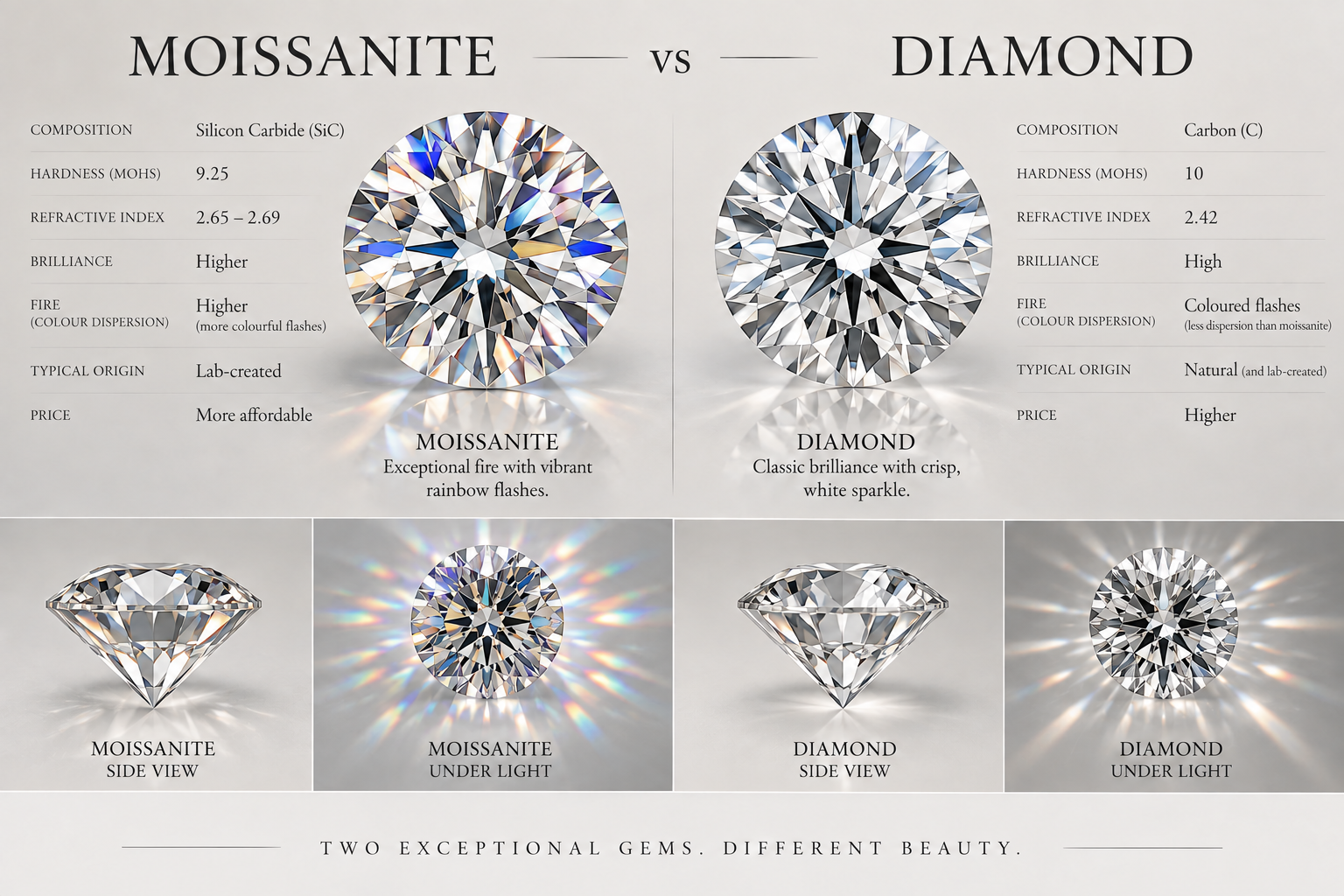
Illustrative comparison of moissanite and diamond. Both can show coloured fire; white sparkle is brilliance. Appearance depends on cut and lighting, and prices vary—compare current quotes.
Comparison image supplied by Anny's. Open the full-size comparison.
What does the price comparison look like in Australia?
If budget is driving your choice, compare three complete-ring quotes: moissanite, lab-grown diamond and natural diamond. The savings depend on the individual stones and specifications being compared.
For context, these are samples from Anny's live loose-diamond listings, checked on 19 September 2026. All are round, G colour, VS2 clarity and listed with Excellent cut. Prices are in Australian dollars, including GST.
| Diamond option | Sample inspected | Listed loose-stone prices |
|---|---|---|
| Natural diamonds | Three sampled listings, each 1.00ct; GIA reports. One was marked unavailable on recheck. | A$5,669–A$6,033 |
| Lab-grown diamonds | Four sampled listings, 1.00–1.05ct; IGI reports | A$1,481–A$1,521 |
These are dated examples, not market averages or finished-ring quotes. The grading laboratories differ, and matching headline grades does not make the stones identical. Prices and availability can change; an online listing does not mean the stone is physically in an Anny's showroom.
For moissanite, ask us for a quote in your preferred shape, dimensions and specifications, with GST and the setting cost stated clearly. Compare that with lab-grown and natural diamond quotes for the complete ring.
The metal, setting, design and manufacture need to be included separately when comparing complete rings. A lower centre-stone price does not remove the cost of making a well-constructed ring.
Give the setting as much thought as the stone
The right ring needs to work on your hand: consider the setting height, band proportions, protection around pointed corners and how a wedding band will sit beside it. A very fine design may look delicate, but it still needs enough structure for the way you wear it.
Similar setting styles can suit either material. Before setting or repair work, a jeweller should assess the stone’s measurements, condition and treatments. Safe repair and heating methods may differ; hardness alone does not determine them.
Anny's designs and manufactures custom jewellery at its Frankston workshop. Our custom-made jewellery service explains the process from design discussion to finished piece. If you are considering moissanite, contact us about current sourcing and suitability for your design.
Choose for the ring you want to wear
If you prefer diamond, our natural vs lab-grown diamond guide helps you compare the options within your complete-ring budget.
If future resale or a trade-in matters, ask for the specific terms in writing before buying. Keep that question separate from a valuation or the original retail price; none is a promise of what a future buyer will pay.
A few final questions
Can a diamond tester mistake moissanite for diamond?
Yes. A basic thermal tester can respond to moissanite, so that reading alone does not prove the stone is diamond. Have its identity checked professionally. Distinguishing natural from lab-grown diamond is a separate identification question. GIA: moissanite research.
What paperwork should I ask for?
For a diamond, check the issuing laboratory's report and the stated growth origin. For moissanite, ask who assigned any colour or clarity descriptions and what document is supplied. A grading report describes a stone; it is not a monetary valuation. Make sure the invoice and any valuation or insurance documents identify the material accurately. IGI: diamond reports, IGI: report and value FAQs.
Could I replace moissanite with diamond later?
Possibly. A jeweller needs to inspect the ring and compare the replacement stone's measurements. The existing setting may work, or it may need alteration or replacement. Discuss the intended change before commissioning the ring if this is part of your plan.
Talk through your ring with Anny's
Bring your preferred shape, an idea of the size you like and your overall budget. We can discuss how those choices translate into a custom ring.
Frankston: 92 Young Street. Walk-ins welcome; no appointment required. Monday–Friday 10am–5pm and Saturday 10am–3pm.
Melbourne CBD: Level 3, 257 Collins Street, for engagement-ring and wedding-ring consultations. Email us before visiting and wait for our email confirmation before coming in. Remodelling consultations take place at our Frankston workshop.
Email info@annys.com.au to discuss your design or arrange a Melbourne CBD appointment.
Further reading
- GIA: natural and laboratory-grown diamonds
- GIA: synthetic moissanite research
- GIA: gem materials and moissanite properties
- GIA: diamond care and cleaning
- GIA: caring for jewellery
- GIA: moissanite identification and dimensions
- IGI: diamond reports
- IGI: report and value FAQs
- GIA: sapphire properties
- IUCr: crystal-system terminology