Lab-grown vs natural diamonds: which should you choose?
Choose lab-grown if you want more diamond for your budget. Choose natural if its geological origin and rarity matter to you. Both are real diamonds and can make a beautiful engagement ring. Neither origin guarantees a better-looking stone: cut, proportions and the individual diamond still matter. The useful question is what you value most, and how much you want to spend on the complete ring.

The differences at a glance
| What matters | Lab-grown diamond | Natural diamond |
|---|---|---|
| Material | Diamond, grown using technology | Diamond, formed within the Earth |
| Appearance | Can look like a comparable natural diamond | Natural origin does not automatically mean more sparkle |
| Budget | Lower prices in the Anny’s sample below | Higher prices in the same sample |
| Rarity | Production can create more diamonds | A finite geological resource |
| Everyday wear | Highly scratch resistant; still needs care | Highly scratch resistant; still needs care |
| Best reason to choose it | The size and quality you want for your budget | The appeal of a diamond formed in nature |
Both have essentially the same chemical, physical and optical properties. Origin is a meaningful difference, even when appearance is very similar. GIA explains the distinction.
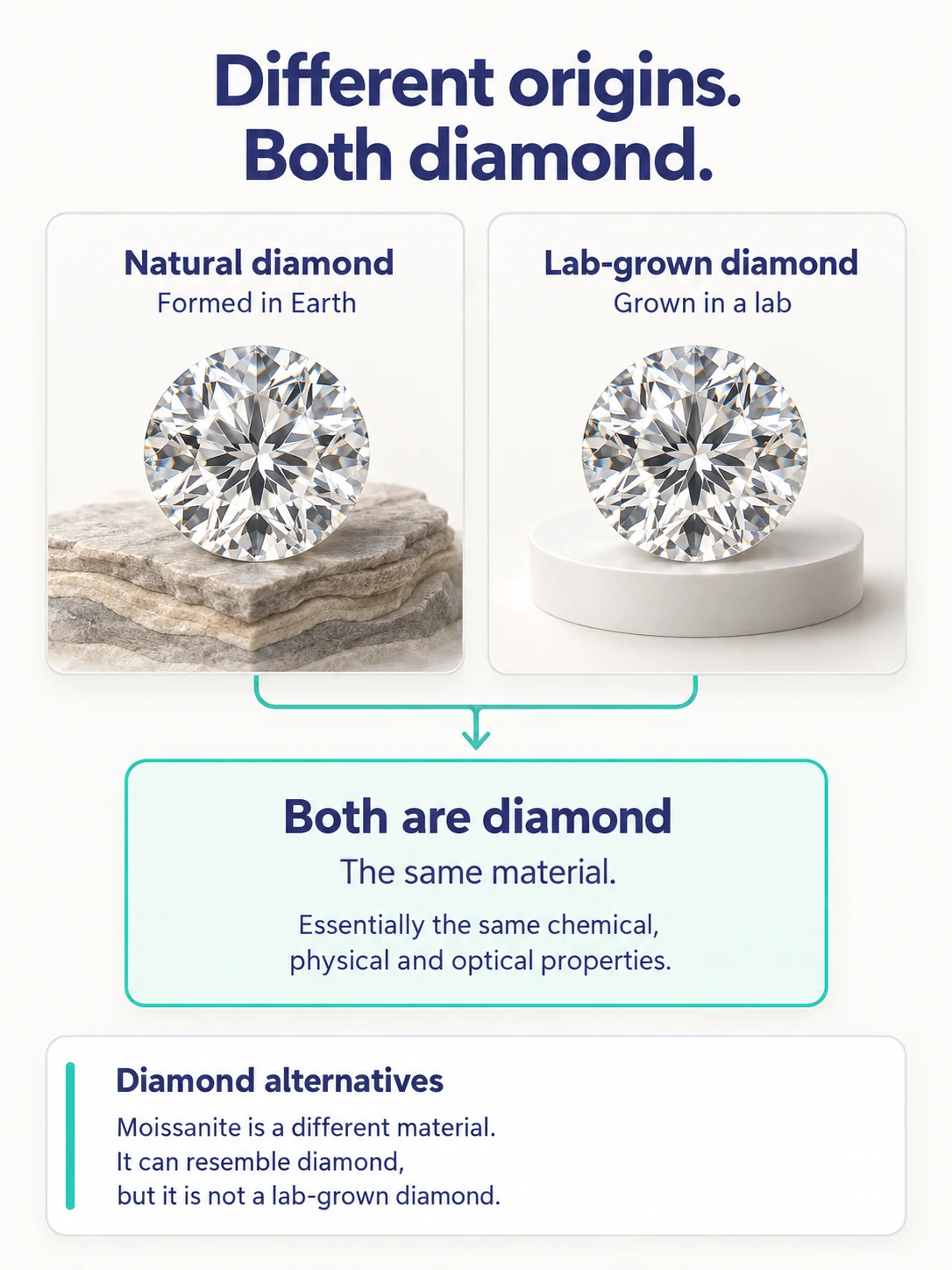
Are lab-grown diamonds real, and can you tell the difference?
Yes, lab-grown diamonds are real diamonds. They are different from moissanite and cubic zirconia, which are other materials used as diamond alternatives.
You cannot reliably establish origin by looking at a ring with the naked eye. Specialist gemmological testing can distinguish the two; an ordinary diamond tester does not establish that a diamond is natural. A photograph cannot prove origin either. GIA’s identification guidance is useful here.
Diamond and simulant properties compared
Lab-grown and natural diamonds share essentially the same chemical, physical and optical properties. Cubic zirconia, moissanite, white sapphire and YAG are different materials that can resemble diamond.
Swipe or scroll sideways to compare all properties.
| Material | Formula | Crystal system | Refractive index | Dispersion | Hardness (Mohs) | Relative density |
|---|---|---|---|---|---|---|
| Lab-grown diamond | C | Cubic | 2.42 | 0.044 | 10 | 3.52 |
| Natural diamond | C | Cubic | 2.42 | 0.044 | 10 | 3.52 |
| Cubic zirconia | ZrO₂ + stabilisers | Cubic | 2.15–2.18 | 0.058–0.066 | 8–8.5 | 5.56–6.00 |
| Moissanite | SiC | Hexagonal* | 2.65–2.69 | 0.104 | 9.25 | 3.22 |
| White sapphire | Al₂O₃ | Trigonal | 1.762–1.770 | 0.018 | 9 | 4.00 |
| YAG | Y₃Al₅O₁₂ | Cubic | 1.833 | 0.028 | 8.25 | 4.55 |
The first two rows share the same typical values. Cut, clarity and other individual features still affect how a diamond looks. These numbers are material properties, not a sparkle rating.
Approximate reference values. *Moissanite figures refer to hexagonal 6H material; other crystal forms can differ. Relative density means specific gravity. YAG is yttrium aluminium garnet. GIA comparison and reference values.
How to read these values
Natural diamonds formed deep within the Earth, generally millions to billions of years ago. Lab-grown diamonds are manufactured using high pressure and high temperature (HPHT), or chemical vapour deposition (CVD), which grows diamond from carbon-containing gas. GIA’s guide to lab-grown diamonds and simulants explains these origins.
The shared properties are easier to see side by side. The alternatives below are different materials; they are not lab-grown diamonds.
Typical approximate values, not measurements of a particular stone. Relative density is specific gravity. Moissanite figures refer to hexagonal 6H material; other crystal forms can differ. CZ values vary with stabilisers.
Refractive index describes light bending; dispersion describes its separation into colours, or “fire”. Neither number is a sparkle score. Mohs hardness measures scratch resistance, not resistance to chipping. Cut and setting still matter for appearance and wear.
Sources: GIA’s diamond and simulant comparison, cubic zirconia study and corundum crystal-structure research.
How much cheaper are lab-grown diamonds in Australia?
These six Anny’s listings were selected on 19 September 2026 and rechecked on 20 September 2026. All are round diamonds, exactly 1.00ct, F colour, VS2 clarity and Excellent cut, but their laboratories and proportions differ. Use the prices as a budget guide, then compare the individual stones and reports.
| Loose diamond | Grading laboratory | Observed prices, three listings |
|---|---|---|
| Natural, 1.00ct round F/VS2 | GIA | A$6,596–A$6,713 |
| Lab-grown, 1.00ct round F/VS2 | IGI | A$1,485 each |
These are six individual listings, not market averages. Prices include GST and cover the loose stone only. Price and availability can change.
About these price examples
The sample includes three listings of each origin, selected from lower-priced results. It is not a current lowest-price offer.
All six list Excellent polish. Symmetry is Very Good in the natural sample and Excellent in the lab-grown sample.
Budget for the setting, metal, design and manufacture as well as the diamond. A lower stone price can leave more room for your preferred design. Listed stones may need to be ordered in; contact us before planning a viewing.
For a typical price at other sizes and shapes, use the calculator below. It puts natural and lab-grown side by side for each shape and carat weight, worked out each night from the diamonds available through us at one stated grade.
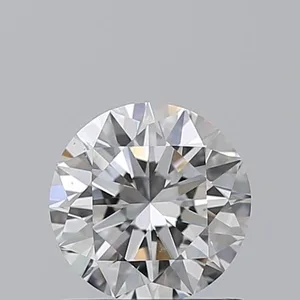
1 ct round · Natural
about A$7,392
Typical price · based on 211 diamonds available through us
Listed now, at or under this price
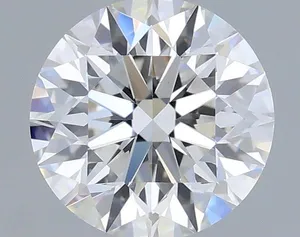
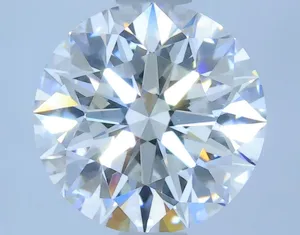
1 ct round · Lab-grown
about A$1,511
Typical price · based on 423 diamonds available through us
Listed now, at or under this price
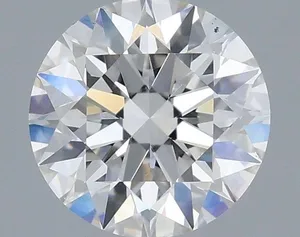
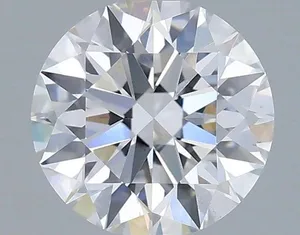
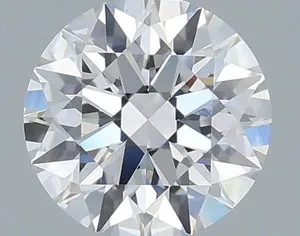
At this size, lab-grown costs about 80% less than natural.
Natural: E–F colour, VS2 clarity, excellent cut for rounds. Lab-grown: E colour, VS1 clarity, ideal cut for rounds. GST included.
Put it in an engagement ringTypical prices of the diamonds available through us, updated 10 October 2026. See every shape and size in our diamond price guide.
Look beyond carat weight
Carat measures weight. It does not tell you everything about how large or lively a diamond looks on your hand.
For sparkle, pay attention to cut: the way a diamond’s proportions, symmetry and polish affect its interaction with light. Shape describes its outline, such as round, oval or pear. Two stones of the same weight can look different, so compare measurements and appearance as well as grades. GIA’s explanation of cut shows why it matters.
With either origin, start with a comfortable complete-ring budget, then consider:
- The shape and proportions you enjoy wearing.
- How the setting sits on your finger and works with a wedding band.
- The individual stone’s appearance, report and price.
Our diamond education guide explains the 4Cs. For the finished piece, Anny’s can design and make a ring around either natural or lab-grown diamonds through our custom-made jewellery service.


Check the actual grading report
A grading report helps you understand what you are buying. Check the origin designation, report number, measurements and quality information, and ask how the stone is matched to its report.
Lab-grown reports use different grading systems:
- IGI continues to use the 4Cs: carat weight, colour, clarity and cut. See IGI’s lab-grown report service.
- GIA introduced Premium and Standard quality assessments for eligible colourless to near-colourless lab-grown diamonds on 1 October 2025. This differs from its earlier reporting system. See GIA’s announcement and current service.
Compare the actual document and report type. A grading report is not a monetary valuation or a promise of future resale value.
What about resale and long-term value?
Choose a diamond you want to wear, within a budget you are comfortable spending. Do not expect a profit or assume you will recover the retail price.
If resale matters, ask what a buyer would actually pay. Read any upgrade or buyback terms in writing before relying on them; a promised return is not a reason to choose either origin.
Natural origin may be part of the meaning for you. Either type of diamond can become a family heirloom; the memories attached to the ring are yours to create.
Is lab-grown automatically the more ethical choice?
The label alone does not answer that question. Ask what information is available about the particular supplier, production, energy use, working conditions and traceability. Environmental and social practices need to be considered throughout the jewellery supply chain. CIBJO’s supply-chain guidance takes that broader approach.
For either origin, claims such as “sustainable” or “eco-friendly” need evidence explaining what is being measured and what the claim covers. Australia’s ACCC guidance on environmental claims recommends clear, specific claims supported by evidence.
If sourcing is central to your decision, raise it when choosing the stone so the available information can be considered alongside its appearance and price.
Two practical questions
How do I keep either diamond looking its best?
Both natural and lab-grown diamonds have high scratch resistance, but either can chip or break from a hard knock. Surface oils and dirt can dull their appearance, so gentle cleaning helps. The setting also needs care. GIA explains gentle cleaning and the difference between hardness and toughness.
Can I inspect a listed diamond before deciding?
Selected stones qualify for Anny’s Seven Day Diamond Showcase and Return Program. Confirm eligibility and payment terms before ordering. The diamond stays in our showroom throughout the seven-day decision period, which begins when it arrives in store. Tell us within that window if you decide against it; we arrange the supplier return and deduct an A$150 shipping and customs fee from your refund. Read the full conditions for your chosen stone.
Find the right diamond for your ring
Bring your ideas and a comfortable budget. We can help you explore natural and lab-grown options and a setting that suits you.
Frankston: 92 Young Street. Walk-ins welcome; no appointment required. Monday–Friday 10am–5pm and Saturday 10am–3pm.
Melbourne CBD: Level 3, 257 Collins Street. Email us before visiting Collins Street for engagement-ring and wedding-ring consultations. Please wait for our email confirmation before coming in. Remodelling consultations take place at our Frankston workshop.