DIAMOND KNOWLEDGE · ANNYS GUIDES
How to tell if a diamond is real
What home tests can tell you, where diamond testers fall short, and how to get a reliable answer.
The short answer
You cannot confirm a diamond with a fog, water or newspaper test. A reliable assessment combines trained examination, suitable equipment and any available paperwork. Some stones need specialist laboratory testing.
Natural and lab-grown diamonds are both real diamonds. Establishing whether a stone is diamond, and whether it formed naturally, are two separate checks. [1]

Start with two questions
Is it diamond?
Natural and lab-grown diamonds share the same carbon crystal structure and essentially the same physical and optical properties. Moissanite and cubic zirconia are different materials that can resemble diamond; they are called simulants. [1]
If it is diamond, is it natural or lab grown?
Finding out how the diamond formed needs a separate assessment. Appearance and an ordinary diamond-tester reading cannot settle it. Our lab-grown vs natural diamonds guide explains the distinction.
For an inherited ring or a secondhand purchase, start with identification. The stone’s history is useful background, but it cannot replace examination.
If it isn’t diamond, what could it be?
Moissanite, cubic zirconia (CZ), white sapphire, glass, colourless quartz, white topaz and zircon can all resemble diamond. They are called simulants when used to imitate it. Zircon and cubic zirconia are different materials. [2]
Technical details: gemstone properties
| Stone | Chemical composition | Crystal system | Refractive index | Dispersion | Mohs hardness | Relative density |
|---|---|---|---|---|---|---|
| Natural diamond | C | Cubic | 2.417 | 0.044 | 10 | 3.52 |
| Lab-grown diamond | C | Cubic | 2.417 | 0.044 | 10 | 3.52 |
| Cubic zirconia (CZ) | ZrO2 | Cubic | 2.15–2.18 | 0.058–0.066 | 8–8.5 | 5.56–6.00 |
| Moissanite | SiC | Hexagonal | 2.648–2.691 | 0.104 | 9.25 | 3.22 |
| White sapphire | Al2O3 | Trigonal | 1.762–1.770 | 0.018 | 9 | 4.00 |
How to read the chart. Refractive index describes how light bends; dispersion relates to rainbow flashes. Mohs hardness ranks scratch resistance, not resistance to chipping, and its scale is not linear. Relative density compares equal volumes with water set to 1.
Typical values are shown. Moissanite crystal form and CZ composition can change the figures. Sapphire is trigonal within the hexagonal crystal family. [2] [3]
Moissanite used in jewellery is normally laboratory-created. CZ is manufactured zirconium dioxide. White sapphire is colourless corundum and can be natural or laboratory-created. Natural and lab-grown diamonds are both real diamonds. [1]
Why home tests do not settle it
These familiar checks are easy to misread. None provides a dependable yes-or-no answer.
| The home test | Why the result is inconclusive |
|---|---|
| Breathing on it | There is no dependable fog-clearing time that proves a stone is diamond. Conditions and the stone’s surface affect what you see. [4] |
| Dropping it into water | Sinking does not identify diamond. Other stones, including quartz, also sink. [5] |
| Reading print or a dot through it | Cut, lighting and positioning affect the result. You cannot use it to identify an unknown stone reliably. [4] |
| Checking its sparkle | Lighting and cut change the appearance of reflections. Rainbow flashes or bright white sparkle are not proof. [4] |
| Looking for a UV glow | Many diamonds show no fluorescence under long-wave UV. A glow, or its absence, cannot establish identity on its own. [6] |
Do not use scratch, sandpaper or heat tests. They can damage a stone or its setting. Avoid experimenting with an unknown piece, particularly one with sentimental value. [4] [7]
A professional check looks at the whole picture
A jeweller or gemmologist may examine the stone under magnification, assess its features and measurements, and use suitable testing equipment. Internal features need skilled interpretation; simply seeing a mark inside a stone does not prove a natural origin. [4]
A setting can obscure parts of a stone and limit testing. Some equipment can screen stones while they remain in jewellery. If the result is uncertain, specialist laboratory examination is the next step. [8]
How we check stones at Anny’s
At Anny’s, we choose tests to suit the stone’s size, colour, cut and setting, and assess the readings alongside examination. Some screening results need further testing; they do not automatically mean a diamond is lab-grown.
How our testing equipment works
The Presidium Gem Tester II (PGT II) measures how readily a stone conducts heat. This helps separate diamond or moissanite from simulants such as cubic zirconia and white sapphire. Diamond and moissanite share its diamond range, so this instrument cannot tell those two apart. Other gemstone readings can overlap, too. [9]
We then use SmartPro MAX, which combines thermal and optical testing. It helps distinguish diamond from moissanite and screens suitable colourless to near-colourless stones for natural or lab-grown origin, including stones set in jewellery. [10]
The MAX’s “Type IIa/CVD/HPHT” category needs further assessment to establish origin: some natural diamonds are also Type IIa. This reading alone does not prove that a diamond is lab-grown. [11] [12]
We also use a liquid-contact refractometer for suitable gemstones, including sapphire. It measures refractive index (RI): how strongly a material bends light. Diamond is beyond a conventional gem refractometer’s measuring range. Other stones also exceed that range, so a reading above the scale cannot confirm diamond. [2]
Match the report to the stone
If you have a grading report, look it up through the issuing laboratory’s official service, such as GIA Report Check. Then ask a jeweller to compare the stone with the report, including its measurements and any laser inscription.
The inscription is a microscopic marking around the stone’s outer edge, known as the girdle. Not every diamond has one. A matching report number is useful evidence, but it is not a guarantee on its own: GIA has documented counterfeit inscriptions on stones that did not match the accompanying reports. [13]
The online lookup checks the report record. Examination checks the stone you actually have.
A few common questions
Can you identify a diamond from a photo?
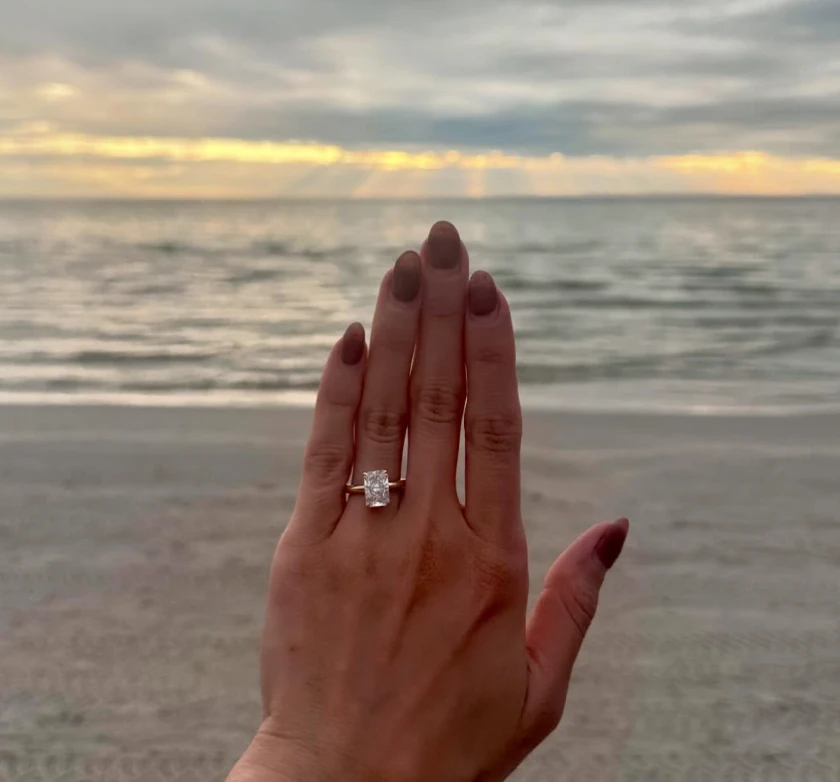
A photo can help explain the style of a piece or an area of concern. It cannot reliably establish the stone’s identity or growth origin. Bring the jewellery itself for assessment.
Does no certificate mean it is not a diamond?
No. Missing paperwork is a reason to have a stone assessed, rather than evidence that it is an imitation. Bring any receipts, old valuations or reports you do have.
Does a gold stamp prove the stone is diamond?
No. A mark such as 18ct or 750 refers to the stated metal content. A gold ring can hold many different gems, so the stone needs its own assessment. [4]
Is identification the same as a valuation?
No. Identification establishes what the stone is. A valuation addresses the piece’s value for a stated purpose. If you need a written document, explain what it will be used for and ask about our jewellery valuation service.
VISIT ANNYS
Not sure about a stone? Bring it to Frankston.
Bring the piece and any paperwork to our Frankston store. Tell us whether you need to identify the stone, establish its origin or obtain a written document. We can discuss the assessment, any further testing, fees and expected timing.
92 Young Street, Frankston. Walk-ins welcome; no appointment required.
Monday–Friday 10am–5pm · Saturday 10am–3pm.
Plan your Frankston visit info@annys.com.au
Our Melbourne CBD showroom is at Level 3, 257 Collins Street. Email us before visiting Collins Street for engagement-ring and wedding-ring consultations. Please wait for our email confirmation before coming in. Remodelling consultations take place at our Frankston workshop.