Melbourne CBD
Melbourne showroom
257 Collins Street, Level 3Melbourne VIC 3000
Email us before visiting Collins Street. Please wait for our email confirmation before coming in.
Arrange your visitDiamonds & Gemstones
A good diamond tennis bracelet comes down to four things: how closely the stones are matched to each other, how securely each one is set, how strong the clasp is, and how well it's sized to be worn every day. A tennis bracelet is dozens of small stones in a continuous line, not one hero stone. That makes it one of the harder pieces to bench-build well — and that's exactly what this guide walks you through.
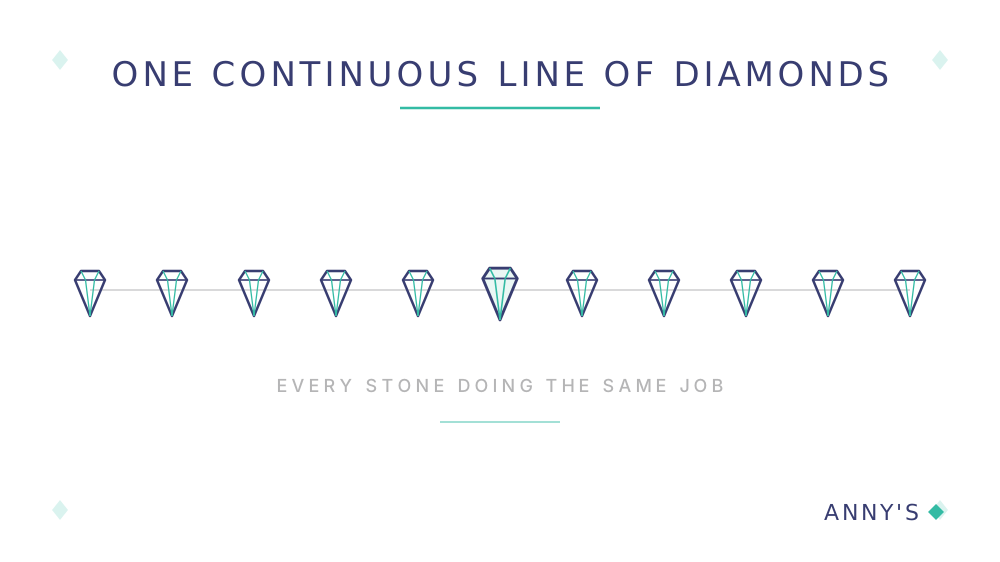
A tennis bracelet is a flexible line of individually set diamonds, joined stone by stone into a continuous, symmetrical strand around the wrist. It was originally called a "diamond line bracelet," a style already fashionable in the Art Deco era, until tennis champion Chris Evert's bracelet came loose and slipped from her wrist mid-match at the U.S. Open. She reportedly called the missing piece her "tennis bracelet" afterwards, and the name stuck.
What hasn't changed is the design logic: one continuous line, no gaps, every stone doing the same job. That simplicity is exactly what makes a tennis bracelet deceptively hard to get right on the bench.
A ring puts most of the pressure on a single centre stone. A tennis bracelet spreads that same pressure across dozens of stones and joins, all of which have to look uniform and hold up to daily flexing at the wrist — with nowhere to hide an inconsistency the way one beautifully cut solitaire can carry a ring on its own.
If even one stone is a shade off in colour or slightly duller in cut, it sits right next to its neighbours and the eye catches the difference immediately — which is why matching dozens of stones convincingly takes time and a setter prepared to be fussy about it. There's a mechanical side too: a ring sits mostly still on the finger, but a bracelet bends constantly at the wrist, all day, and the clasp does all the work of keeping it on.
This is exactly the kind of quality-control problem an in-house workshop is built for. At Anny's, diamond setters, jewellers and CAD designers work together under one roof at our Frankston workshop, rather than a job being handed between separate contractors in different towns — see our custom and repair services for how our team works together on a piece like this.
Matching means the diamonds are closely aligned across the same 4Cs used to grade any single diamond — cut, colour, clarity and carat — so the line reads as one clean, uniform strand rather than a row of individually decent but visibly different stones. Cut is the C that does most for sparkle — more than colour or clarity — which is why it's worth asking your jeweller how the stones were selected for consistency of cut first, not just what grade is on the paperwork.
The sameness across every stone does as much visual work as the grade of any one stone: two bracelets can carry identical average grades on paper and look noticeably different once set, purely because of how consistently their stones were matched to each other.
Total carat weight (TCW) is the combined weight of every stone in the bracelet, not the size of any single one — and the same TCW can be built from many smaller stones or fewer larger ones, with a genuinely different look and price either way. There's no single "correct" total weight, just a trade-off between look, feel and budget.
More, smaller stones read as a fine, continuous shimmer, delicate and comfortable for everyday wear. Fewer, larger stones read as bolder and more prominent, and generally cost more per carat than the same total weight in smaller stones, because larger rough diamonds are rarer relative to what's cut from them. Neither approach is "better" — it depends on whether you want the bracelet to disappear quietly into daily wear or make a statement.
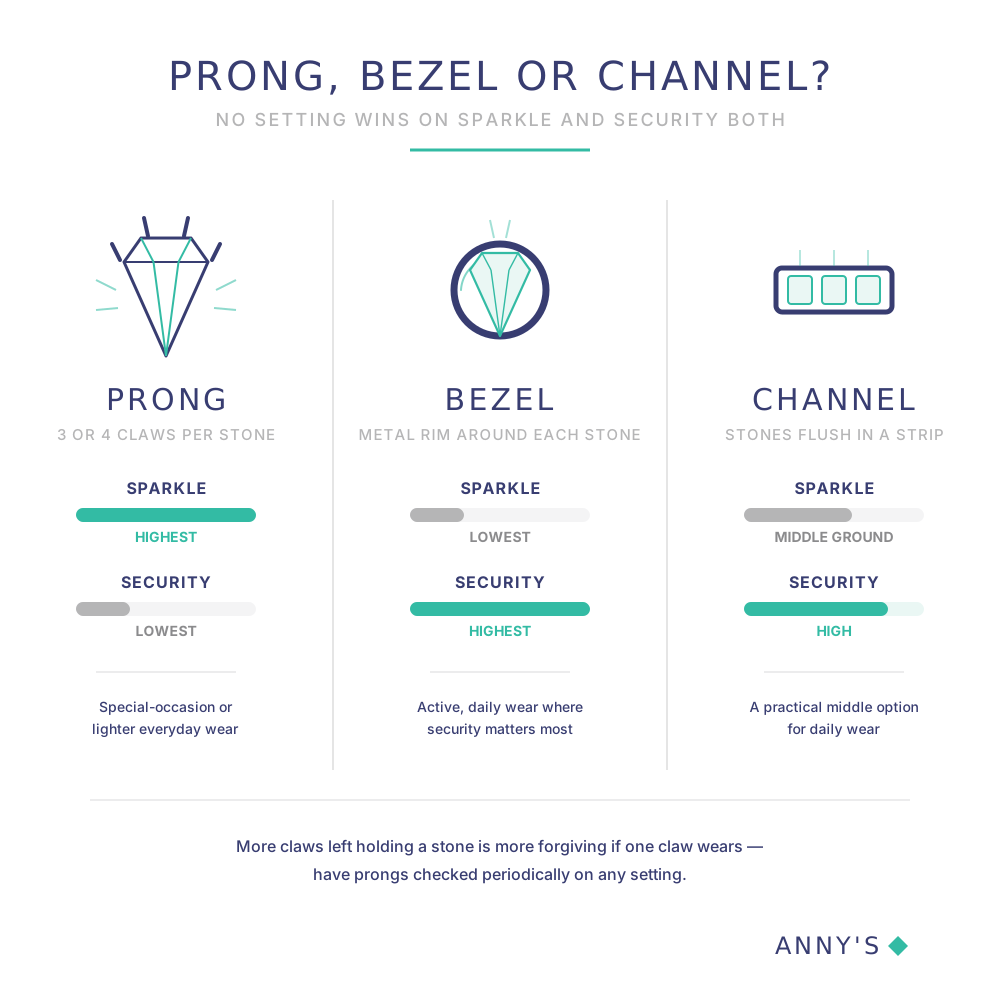
The setting is the metalwork that holds each stone in place, and it's a direct trade-off between maximum sparkle and maximum security — no setting wins on both.
| Setting | Sparkle | Security | Best for |
|---|---|---|---|
| Prong (3 or 4 claws per stone) | Highest — light enters from the sides as well as the top | Lowest of the three — a worn or bent claw raises the risk of a loose stone | Special-occasion or lighter everyday wear |
| Bezel (a metal rim around each stone) | Lowest — the rim blocks some side light | Highest — the stone is protected from knocks on every side | Active, daily wear where security matters most |
| Channel (stones sit flush in a continuous strip) | Middle ground — sparkle comes mainly from the top | High — no protruding claws to catch or bend | A practical middle option for daily wear |
A 4-prong setting is generally more forgiving than a 3-prong one if a claw wears down, simply because more claws are left holding the stone. Whichever you choose, it's worth having the prongs checked periodically — worn prongs are one of the more common, quietly developing risks on a piece worn every day.
 View full size
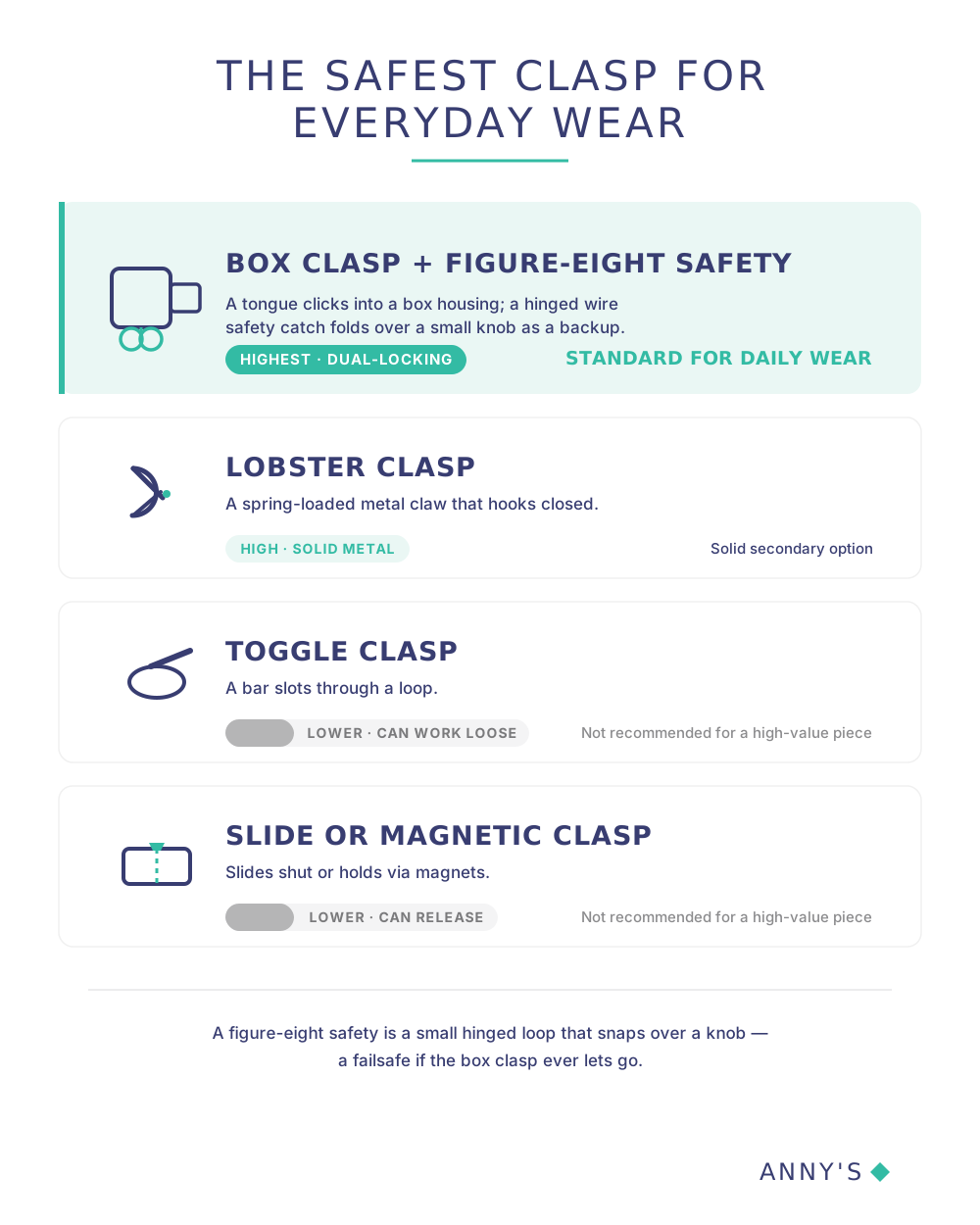
The clasp is arguably the single most important mechanical part of a tennis bracelet — the one component holding dozens of diamonds on your wrist. A box clasp paired with a figure-eight safety catch is the standard, most secure option for daily wear.
| Clasp type | How it works | Security | Recommended for a valuable bracelet? |
|---|---|---|---|
| Box clasp + figure-eight safety | A tongue clicks into a box housing; a hinged wire safety catch folds over a small knob as a backup | Highest — a genuine dual-locking system | Yes — the standard choice for daily wear |
| Lobster clasp | A spring-loaded metal claw that hooks closed | High — solid metal construction resists pulling | Yes, as a solid secondary option |
| Toggle clasp | A bar slots through a loop | Lower — can work loose under the wrong angle | Not recommended for a high-value piece |
| Slide or magnetic clasp | Slides shut or holds via magnets | Lower — can release under pressure or against metal objects | Not recommended for a high-value piece |
The figure-eight safety is a small, hinged loop that snaps over a knob on the main clasp, purely as a failsafe if the box clasp ever lets go — the difference between merely secure and genuinely hard to lose. If yours doesn't have one and you wear the piece often, it's worth asking about.
A clasp opens and closes every time you wear the bracelet, for years. If it ever feels loose, stiff, or doesn't click shut with confidence, get it checked. Our in-house repair service covers chain and clasp repairs at the Frankston workshop, done by the same team that sets the stones.
 View full size
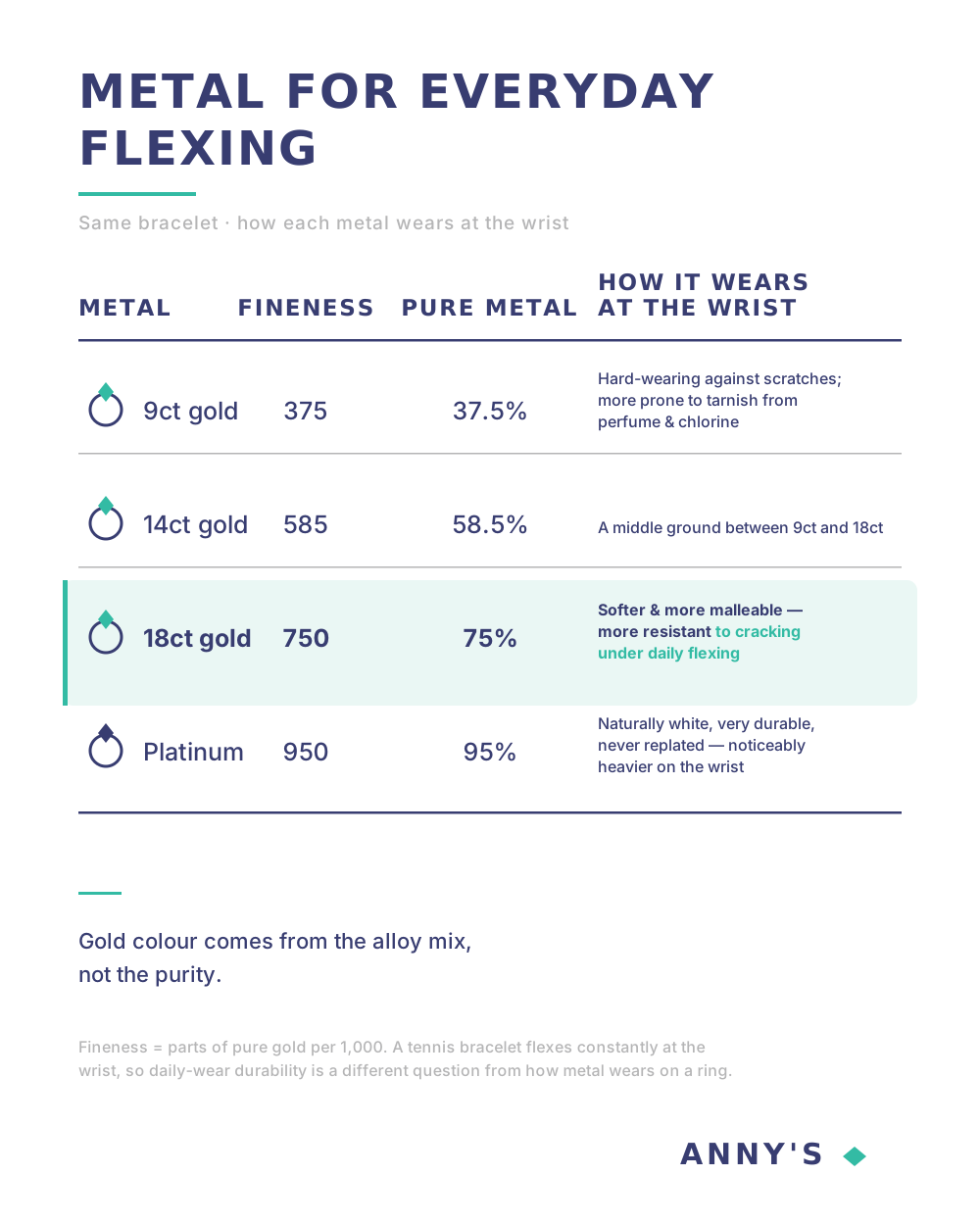
Metal choice affects how a tennis bracelet holds up to constant flexing at the wrist — a different question from how metal wears on a ring that mostly sits still. Anny's offers 9ct, 14ct and 18ct gold — in yellow, white and rose — plus platinum.
18ct gold (75% pure) is softer and more malleable than 9ct gold (37.5% pure), which in practice makes it more resistant to cracking under a bracelet's daily bending, at a higher cost. 9ct gold is harder wearing against scratches but more prone to tarnishing from everyday chemicals like perfume and chlorine. Platinum is naturally white and noticeably heavier on the wrist than a gold bracelet of the same design; its care needs depend on wear, construction and condition, so it is worth trying on and discussing rather than just costing out.
Gold colour (yellow, white or rose) comes from the alloy mix, not the purity. White gold is commonly rhodium-plated for extra brightness, and that plating wears and gets reapplied over the years.
 View full size
A well-sized tennis bracelet sits close enough not to slide around, but loose enough to move naturally with your wrist — not so tight it marks the skin, not so loose it swings into things. Getting there starts with an accurate wrist measurement.
Wrap a soft measuring tape snugly around your wrist, just below the wrist bone, without pulling tight (a strip of paper or string, measured against a ruler, works too). Add a small comfort allowance, and check you can fit one to two fingers between the bracelet and your wrist once fastened. Measure at day's end if you can — wrists swell slightly the same way fingers do.
Buying as a surprise gift? Borrowing and measuring a bracelet or watch the person already wears comfortably beats guessing.
Yes — and a grading report can matter more here than on a single-stone piece, because you're trusting a consistency claim across dozens of stones. Ask which laboratory reports or other documentation are available for the chosen stones and what they cover. Small accent diamonds may be documented as part of the finished piece rather than individually graded; a report is not a certification label.
Worth knowing: not every stone in a bracelet will necessarily carry its own separate grading report, because reports have traditionally focused on larger stones. That's not a red flag — just ask your jeweller what documentation comes with the piece as a whole.
An Anny's-supplied written valuation is separate again, recording what the bracelet is and what it would cost to replace — which matters for insurance. Our guide to valuing and insuring a piece like this covers written valuations and revaluation timing in more depth; the same principles apply to a bracelet as to a ring.
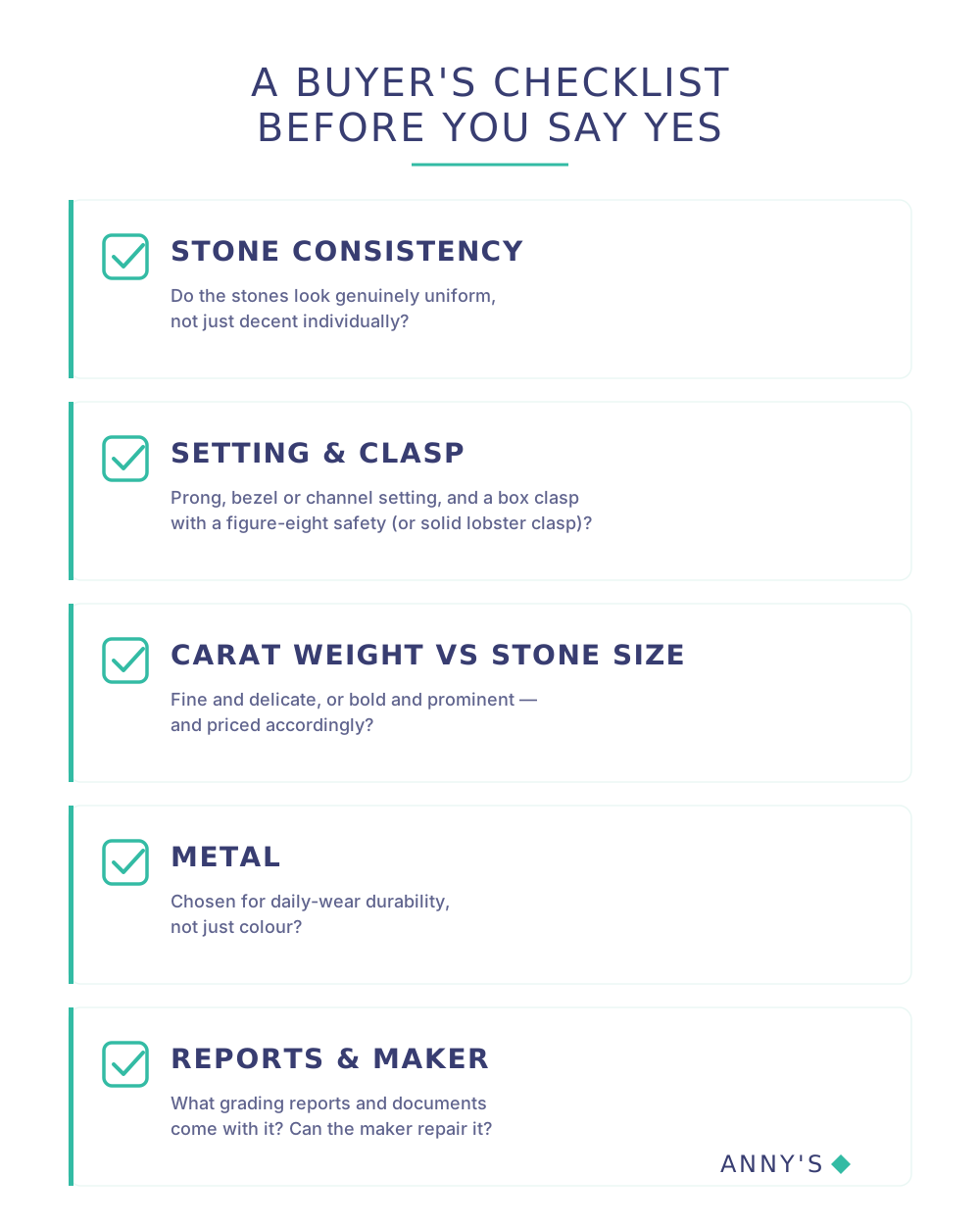
| Check | Quick question to ask |
|---|---|
| Stone consistency | Do the stones look genuinely uniform, not just decent individually? |
| Setting & clasp | Prong, bezel or channel setting, and a box clasp with a figure-eight safety (or solid lobster clasp)? |
| Carat weight vs stone size | Fine and delicate, or bold and prominent — and priced accordingly? |
| Metal | Chosen for daily-wear durability, not just colour? |
| Reports & maker | What grading reports and documentation come with it, and can you go back to the maker for repairs? |
Explore our jewellery range or Email us to speak with our in-house team — the same diamond setters, jewellers and CAD designers who'd build your bracelet are the ones you'll speak to.
 View full size
Often, yes — links can usually be added or removed to adjust the length, much like a watch bracelet. It's best done by a workshop that understands how the original clasp and setting were built.
Mostly down to the setting and clasp, not the stones — a bezel or channel setting with a box-and-safety clasp is the most forgiving for active daily wear. Even then, it's sensible to remove fine jewellery for contact sports or swimming in chlorinated water.
Yes — lab-grown diamonds are real diamonds, chemically and optically identical to natural ones, just grown in a laboratory rather than formed in the earth, and Anny's offers both. The choice is personal, suited to your budget and values.
Compare like with like: total carat weight, cut quality, setting type, clasp type and metal all move the price. A cheaper bracelet with a similar headline carat weight has usually saved money somewhere in that list — ask which factor accounts for the difference.
Thinking about a diamond tennis bracelet? Explore our jewellery range, then Email us about visiting our Frankston workshop. The same diamond setters, jewellers and CAD designers who'd build your bracelet are the ones you'll speak to — no pressure, just good advice. You Imagine. We Create.
Typical engagement and bridal ring turnaround: 3–4 weeks from CAD sign-off. We also have 2-week and 48-hour options for engagement and bridal rings. Get in touch and we'll help find an option that works for your timeframe.
Made personal, at Anny's
Melbourne CBD
Email us before visiting Collins Street. Please wait for our email confirmation before coming in.
Arrange your visitOur Frankston home
Visit us to talk through your ideas, explore designs and find your perfect fit.
Explore our Frankston showroomTypical engagement and bridal ring turnaround: 3–4 weeks from CAD sign-off. We also have 2-week and 48-hour options for engagement and bridal rings. Get in touch and we'll help find an option that works for your timeframe.
Typical repair turnaround: 1 to 7 business days, depending on complexity and customer urgency
Anny's Manufacturing JewellersABN 88 447 171 579